
What Is an Electrical Panel?
Your home's electrical panel — sometimes called the breaker box, load center, or service panel — is the central distribution point for all the electricity your utility delivers to your home. Utility power enters through a service entrance, passes through a meter, and then flows into the panel, where it gets divided into individual circuits that run to different areas of your home.
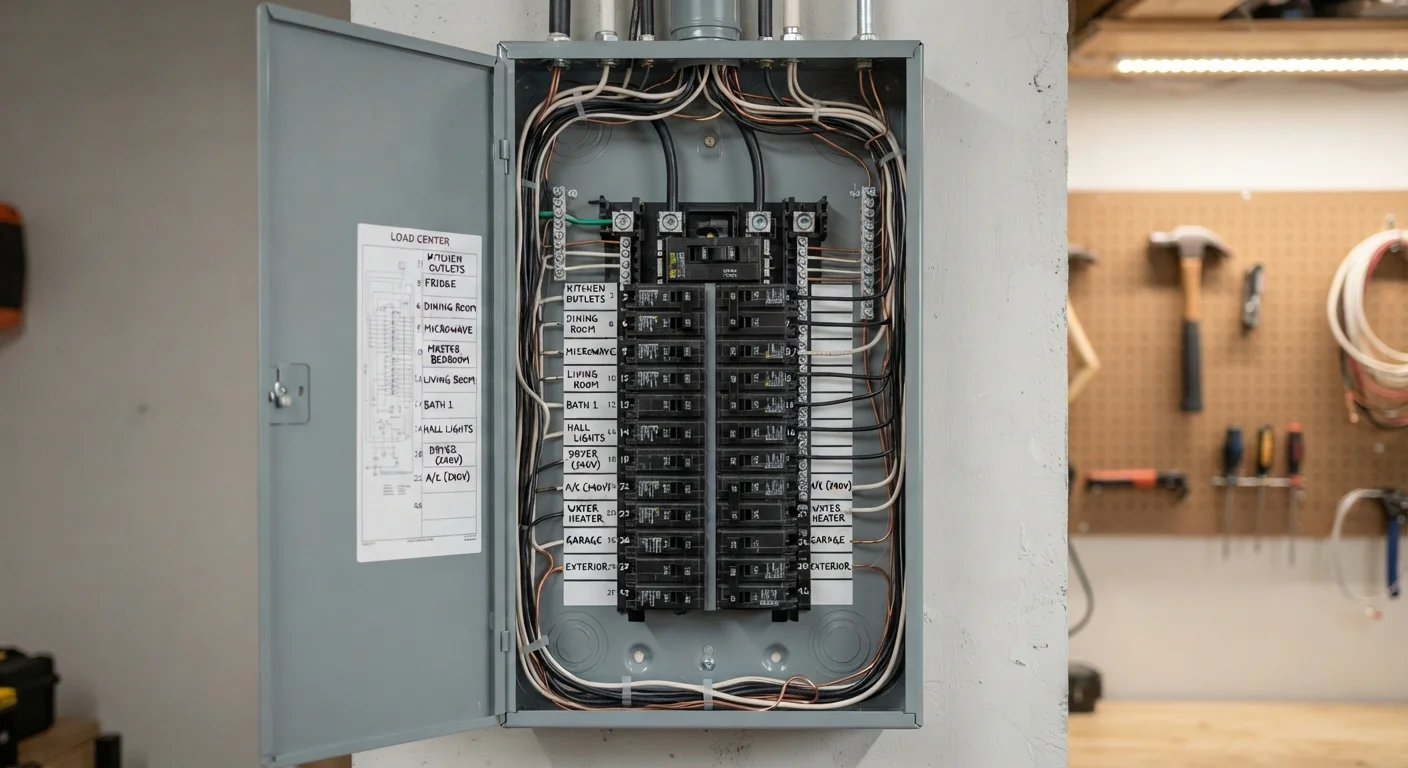
Inside the panel you'll find a main breaker (which controls power to the entire box), two rows of individual circuit breakers, and bus bars — metal strips that carry current from the main breaker to each individual breaker slot. Understanding this layout helps you respond confidently when something goes wrong, rather than guessing in the dark.
Circuit breaker
A resettable switch that automatically cuts power to a circuit when it detects more current than the circuit is rated to handle safely.
Amperage (amps)
A measure of how much electrical current is flowing. Every breaker and circuit has an amperage rating that sets its safe maximum load.
Main breaker
The large breaker at the top of the panel that controls power to all circuits in the box at once. Flipping it cuts all household power except at the meter.
GFCI outlet
A Ground Fault Circuit Interrupter outlet that shuts off power within milliseconds if it detects current leaking to a grounded surface, reducing shock risk near water.
Bus bar
A metal strip inside the panel that distributes electrical current from the main breaker to each individual circuit breaker slot.
Service entrance
The point where utility power lines connect to your home, typically through a weatherhead or underground conduit, before passing through the meter and into the panel.
Circuit Breakers and How They Work
Each circuit breaker is both a switch and a safety device. It controls a specific circuit — say, your kitchen counter outlets or your bedroom lights — and automatically shuts off when that circuit draws more current than it's rated for. This prevents wiring from overheating, which is a leading cause of house fires.
Breakers have three positions: ON, OFF, and a middle tripped position that sits between the two. When a breaker trips, the switch snaps to that middle position or shifts slightly toward OFF. Single-pole breakers handle 120-volt circuits and fit in one panel slot. Double-pole breakers span two slots and handle 240-volt circuits for large appliances like dryers and electric ranges.
Label Every Breaker Now
Take 20 minutes to map and label each breaker in your panel before you ever need to use it in an emergency. Turn on lights and devices in each room, then flip breakers one at a time to identify which controls what. Write clear labels directly on the panel's directory card — most panels have one inside the door.
Understanding Amperage and Panel Capacity
Amperage (amps) measures how much electrical current a circuit or panel can safely carry. Each breaker is rated for a specific amperage — typically 15 or 20 amps for standard household circuits. Exceed that rating and the breaker trips.
Your panel also has a total capacity, expressed in amps. Most homes built after the 1970s have 100-amp or 200-amp service. Older homes may still have 60-amp panels or even fuse boxes, which can struggle to power modern appliances, EV chargers, or home offices safely. If your household's power demands have grown significantly, a panel upgrade may be worth discussing with a licensed electrician — though that's a decision based on your specific setup, not a general prescription.
Fuse Boxes Are a Different System
Some older homes still use fuse boxes rather than circuit breakers. Instead of resetting a tripped breaker, fuses must be physically replaced when they blow. If your home has a fuse box, it's worth having a licensed electrician assess whether it meets your current household's needs, since fuse box capacity and safety standards predate many modern appliances.
Why Breakers Trip — and What to Do
Breakers trip for three main reasons:
- Overloaded circuit: Too many devices drawing power at once exceed the breaker's amperage rating. This is the most common cause.
- Short circuit: A hot wire touches a neutral wire — often inside a damaged outlet or appliance — causing a sudden surge. The breaker trips almost instantly.
- Ground fault: A hot wire contacts a grounded surface. GFCI outlets in bathrooms and kitchens are designed specifically to catch these quickly.
To reset a tripped breaker, unplug devices on that circuit, switch the breaker firmly to OFF, then back to ON. If it trips again right away, or if you smell burning, stop using that circuit and contact an electrician. Frequent tripping is a signal, not just an inconvenience — treat it like a warning light on a dashboard. For more on reading household warning signs, see our guide to DIY fixes that often go wrong.
When to Call a Licensed Electrician
Resetting a breaker is well within a homeowner's ability. Almost everything else inside the panel is not. Work inside an energized electrical panel carries serious risks of electrocution and fire, and in most jurisdictions it requires both a licensed electrician and a permit from your local building department.
Call a licensed electrician for any of the following:
- A breaker that keeps tripping after being reset
- A burning smell, scorch marks, or buzzing sounds from the panel
- Flickering lights throughout the house
- Adding a new circuit or sub-panel
- Upgrading panel capacity
- Replacing a faulty breaker
Never Work Inside a Live Panel
Even when individual breakers are switched off, the main lugs — the large terminals where utility power enters the panel — remain energized at all times. There is no safe way for a homeowner to de-energize these without utility company involvement. Any internal panel work should be left to a licensed electrician.
When hiring an electrician, verify their license with your state's contractor licensing board and confirm they'll pull the necessary permits. Unpermitted electrical work can complicate home sales and void homeowner's insurance claims.
This article is for general informational purposes only and does not constitute electrical, safety, or legal advice. Always consult a licensed electrician and verify local code requirements before undertaking any electrical work in your home.