
Why Knife Skills Are Worth Your Time
Good knife technique isn't just about looking confident in the kitchen — it genuinely changes the cooking experience. When you can break down an onion in under a minute or julienne a carrot without wrestling it across the board, prep stops feeling like a chore and starts feeling like part of the process.
Knife skills also directly affect how food tastes. Uniform cuts mean uniform cooking — no more half-burned, half-raw edges in the same pan. And beyond efficiency, proper technique is simply safer. Counter to intuition, a sharp, well-controlled knife requires less pressure and is far less likely to slip than a dull one you're forcing through food.
If you're just building your kitchen confidence, our beginner's guide to your first week of home cooking covers the broader foundation — knife skills fit naturally into that picture.
What you will need
Chef's Knife (8-inch)
The workhorse of the kitchen — handles chopping, slicing, dicing, and mincing for most everyday tasks.
Cutting Board
Provides a stable, safe surface for all knife work and protects your countertops.
Honing Steel
Realigns the knife's edge between sharpenings to maintain consistent cutting performance.
Paring Knife
Useful for detail work like peeling, trimming, and segmenting small items that are awkward on a board.
Damp Towel or Non-Slip Mat
Placed under the cutting board to prevent it from sliding while you cut.
Step-by-Step: Core Knife Techniques
Work through these steps in order. The first three — station setup, pinch grip, and the claw — are the safety and control foundation everything else builds on. The cuts in steps four through six cover the majority of what you'll encounter in everyday recipes.
Set up a stable, safe cutting station
Place your cutting board on a damp dish towel or a rubber non-slip mat. A board that slides is one of the most common causes of kitchen accidents. Make sure the board has enough room for the ingredient you're prepping — crowding leads to rushed, awkward cuts.
Master the pinch grip
Grip the blade — not the handle — between your thumb and the side of your bent index finger, right where the blade meets the bolster (the thick band between blade and handle). Wrap the remaining fingers loosely around the handle. This grip gives you far more control and precision than holding only the handle, and reduces wrist strain during longer prep sessions.
Use the claw technique to protect your fingers
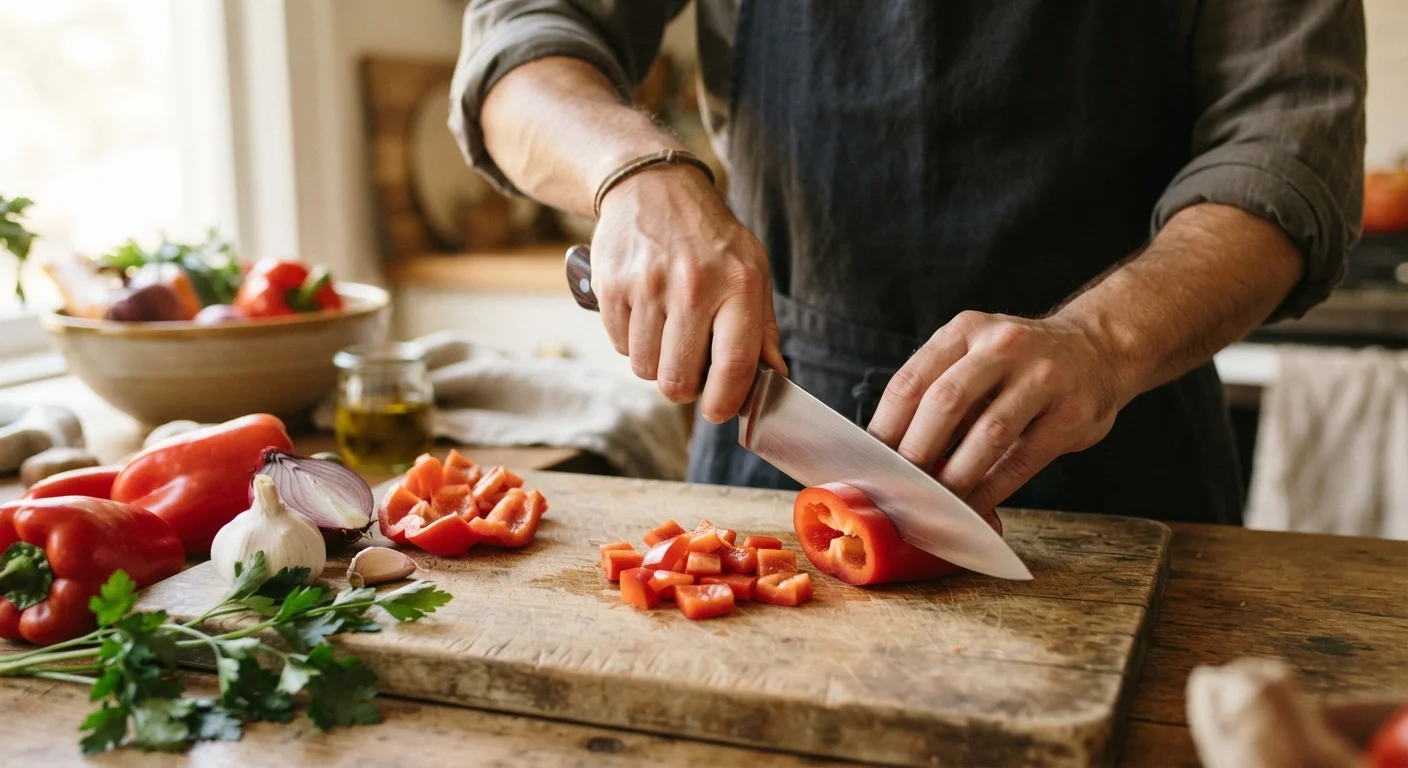
With your non-knife hand, curl your fingertips under so your knuckles face the blade. Rest the flat side of the blade against your knuckles as you cut — your knuckles act as a guide, and your fingertips stay safely tucked away. Advance your hand backward slightly with each cut to control slice thickness.
Practice the basic dice
A dice is one of the most useful cuts in cooking. Start with a stable base: cut a flat side on rounded vegetables so they don't roll. Make parallel slices lengthwise, then rotate and slice across to create even cubes. For a small dice, aim for about ¼-inch cubes; a medium dice is roughly ½ inch. Uniform size means everything cooks at the same rate.
Learn the julienne (matchstick) cut
A julienne produces thin, uniform matchstick strips — ideal for stir-fries, salads, and garnishes. Slice your vegetable into planks about ⅛ inch thick, stack the planks, then cut lengthwise into thin strips of the same width. Aim for about 2–3 inches in length for most applications. Carrots and bell peppers are perfect for practicing this cut.
Add the chiffonade for leafy greens and herbs
Chiffonade (shih-fuh-NAHD) turns leafy greens and fresh herbs into fine ribbons. Stack your leaves, roll them tightly into a cylinder, then slice across the roll in thin strips. It's the ideal cut for basil, mint, kale, and cabbage. The tighter the roll, the finer and more uniform the ribbons.
Practice on Something Low-Stakes First
When learning a new cut, reach for a forgiving vegetable — something firm enough to hold its shape but not so hard it fights back. Zucchini, cucumbers, and bell peppers are ideal for practicing grip and claw technique. Save the harder carrots and butternut squash until the motion feels natural.
Putting It All Together in the Kitchen
Once these techniques feel comfortable in isolation, the real payoff comes from combining them. A simple stir-fry, for example, might call for julienned carrots, diced onion, and a chiffonade of basil to finish — three cuts, one dish, and a noticeably better result than rough, uneven pieces.
Keep your knife honed regularly (a honing steel before each session takes about 30 seconds) and sharpened periodically. A well-maintained edge makes every technique easier and more enjoyable.
From here, the natural next step is learning to cook without a recipe — a skill that becomes much more accessible once you can handle ingredients quickly and confidently. And if you want to put those cuts to immediate use, our complete egg reference for home cooks is a great place to start — eggs are one of the most technique-driven ingredients in the kitchen.
Never Leave a Knife at the Edge of a Counter
Always place your knife flat in the center of the cutting board or on a magnetic strip when not actively cutting. Knives at counter edges get knocked off, and reaching across a cluttered surface with a blade nearby is a common way accidents happen. Make placement a habit from the start.