

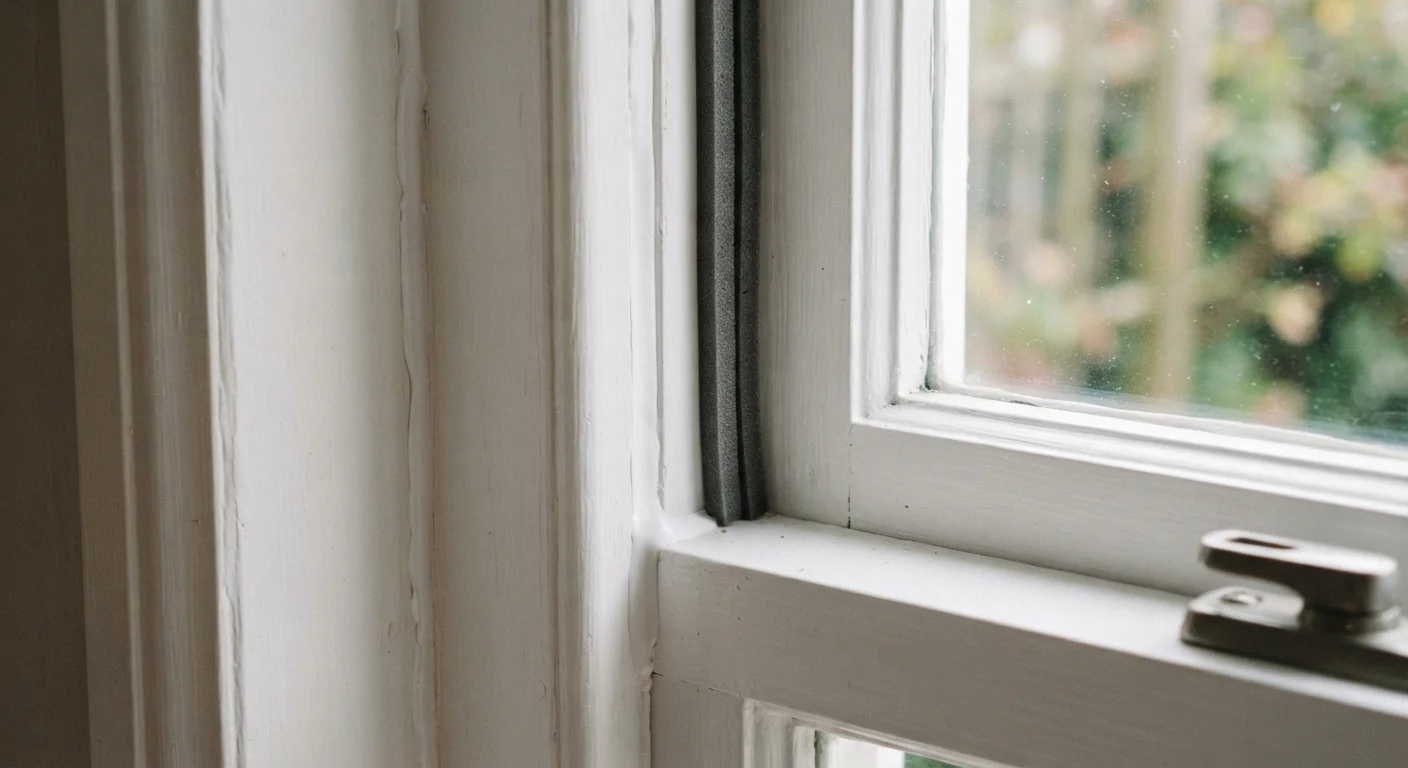
Why the Wrong Choice Fails Fast
Air sealing is one of the highest-return maintenance tasks a homeowner can do — but only when each material is used where it belongs. Caulk and weatherstripping share the same general goal: keep conditioned air in and outdoor air out. The critical difference is motion.
Caulk is an adhesive sealant that cures into a semi-flexible solid. It grips both surfaces it touches and bridges the gap between them permanently. Apply it anywhere those surfaces move against each other and the bond will shear apart — often within weeks. Weatherstripping, by contrast, is a compressible material that creates a seal through pressure rather than adhesion. It's designed to be compressed thousands of times without losing its shape or function.
Understanding this single principle — stationary gaps get caulk, moving gaps get weatherstripping — will save you from redoing the work every season. For a broader look at where drafts tend to hide before winter, see our fall home walkthrough checklist.
| Criterion | Caulk | Weatherstripping |
|---|---|---|
| Best application | Stationary gaps and cracks | Moving parts (doors, operable windows) |
| Bond type | Adhesive — bonds to both surfaces | Compression — seals via pressure |
| Handles repetitive movement | No — cracks and fails | Yes — designed for it |
| Typical lifespan | 5–10+ years in correct locations | 2–5 years depending on material and traffic |
| Skill level required | Beginner DIY | Beginner DIY |
| Common materials | Latex, silicone, siliconized latex | Foam, V-strip, bulb gasket, door sweep |
| Can be painted over | Yes (latex types) | Generally no |
Where Caulk Belongs
Reach for caulk wherever two non-moving surfaces meet and leave a gap. Common locations include:
- Window and door frames against exterior siding or interior drywall — the frame is fixed; the gap is permanent.
- Baseboards and trim against walls — particularly in older homes where settling has opened seams.
- Pipe, wire, or duct penetrations through walls, floors, or ceilings — irregular shapes that only caulk can fill and seal around.
- Between the sill plate and foundation — a major source of basement drafts that is easily overlooked.
For most residential projects, a paintable latex or siliconized latex caulk works well on interior joints, while a 100% silicone formulation holds up better in wet or extreme-temperature areas like around exterior window perimeters. Always clean and dry the surface before applying — caulk won't adhere properly to dust or moisture.
25–30%
Of home heating and cooling lost through air leaks
The U.S. Department of Energy estimates that air leaks account for roughly 25–30% of a home's heating and cooling energy use.
$0.50–$3
Approximate cost per linear foot of weatherstripping
Most consumer-grade foam and V-strip weatherstripping falls in this range, making door and window sealing one of the more cost-accessible maintenance tasks.
Where Weatherstripping Belongs
Weatherstripping is the right tool anywhere a seal must compress and release repeatedly. The main types and their placements:
- Foam tape: Easy to apply; best for low-traffic windows and the tops or sides of interior attic hatches. Compresses well initially but tends to flatten faster than other types.
- V-strip (tension seal): A durable folded plastic or metal strip that springs open to fill gaps on the sides of double-hung windows and along the edges of door frames. Holds up well to repetitive use.
- Door sweeps: Attached to the bottom of an exterior door to seal the gap against the threshold. Available in automatic (rises when the door opens) and standard slide-on styles.
- Bulb or tubular gasket: Compresses to a complete seal when a door closes; works well on the door stop (the strip the door presses against when shut).
When inspecting a door, check all four sides: the two vertical jambs, the top, and the bottom. Each side may call for a different weatherstripping profile depending on the gap size and closure pressure.
Applying Both Correctly — Tips to Make It Last
Good preparation is the difference between a seal that lasts years and one that peels away by spring.
For caulk:
- Remove all old caulk with a plastic scraper or caulk remover tool.
- Clean the surface with rubbing alcohol and let it dry completely.
- Apply a steady, consistent bead and smooth it immediately with a dampened finger or caulk tool.
- Allow full cure time before painting or exposing to moisture — read the product label for specifics.
For weatherstripping:
- Clean the contact surface with a degreaser so adhesive backing grips firmly.
- Measure and cut strips to length before peeling backing — cutting after sticking creates ragged edges.
- Close the door or window slowly on the strip to confirm it compresses evenly without binding.
- Replace weatherstripping that has hardened, cracked, or lost its spring — compressed-flat material provides almost no insulation value.
Neither task requires special skills. A caulking gun, a utility knife, and a tape measure are sufficient for most jobs. Doing both in the right places — rather than defaulting to one product everywhere — is what produces a genuinely tight home.
When You Need Both on the Same Window
Double-hung windows are a common source of confusion. The fixed perimeter — where the window frame meets the wall — gets caulked. The sashes that slide up and down get weatherstripped along their channels. Using caulk on the sash track would seal the window shut. When in doubt, ask yourself: does this part move? If yes, weatherstrip it. If no, caulk it.