
Why Eggs Belong in Every Cook's Repertoire
No single ingredient pulls as much weight in a kitchen as the egg. It can be a complete meal on its own, a structural backbone in baked goods, a silky sauce base, or an invisible binder holding a meatball together. That range is exactly why professional cooks treat egg cookery as a core skill — and why home cooks benefit enormously from understanding it well.
If you're just finding your footing in the kitchen, eggs are an ideal starting point. Our practical first-week cooking guide leans on eggs heavily for a reason: they're forgiving, fast, and affordable. This reference goes deeper, giving you the vocabulary and technique to work with eggs confidently across every scenario.
6g
Protein per large egg
According to USDA FoodData Central, one large egg delivers approximately 6 grams of complete protein.
6
Functional culinary roles eggs play
Culinary educators commonly identify binding, emulsifying, leavening, thickening, glazing, and coating as the six core egg functions in cooking.
40°F
USDA-recommended max storage temp
The USDA advises keeping shell eggs refrigerated at or below 40°F to reduce risk of bacterial growth.
Egg Anatomy and What Each Part Does
A chicken egg has three main components, and each one behaves differently in the kitchen.
- The shell is primarily calcium carbonate — porous enough that eggs can absorb odors in your fridge (another reason to keep them covered).
- The white (albumen) is mostly water and protein. It firms up when heated and whips into foam when beaten, trapping air. That foam is what makes angel food cake light and soufflés rise.
- The yolk contains fat, cholesterol, vitamins, and lecithin — a natural emulsifier. Lecithin is what allows oil and water to stay blended in mayonnaise and hollandaise sauce.
The chalaza — those white stringy cords attached to the yolk — is not a defect. It holds the yolk centered in the white and is perfectly edible. Fresh eggs have more prominent chalazae; their presence is actually a sign of quality.
Temper eggs before adding them to hot liquids: whisk a spoonful of the hot mixture into the yolks first, then stir the warmed yolks back in. This prevents scrambling in custards and sauces.
Gradual heat equalization gives the egg proteins time to set gently rather than seizing all at once — the difference between silky curd and curdled scramble.
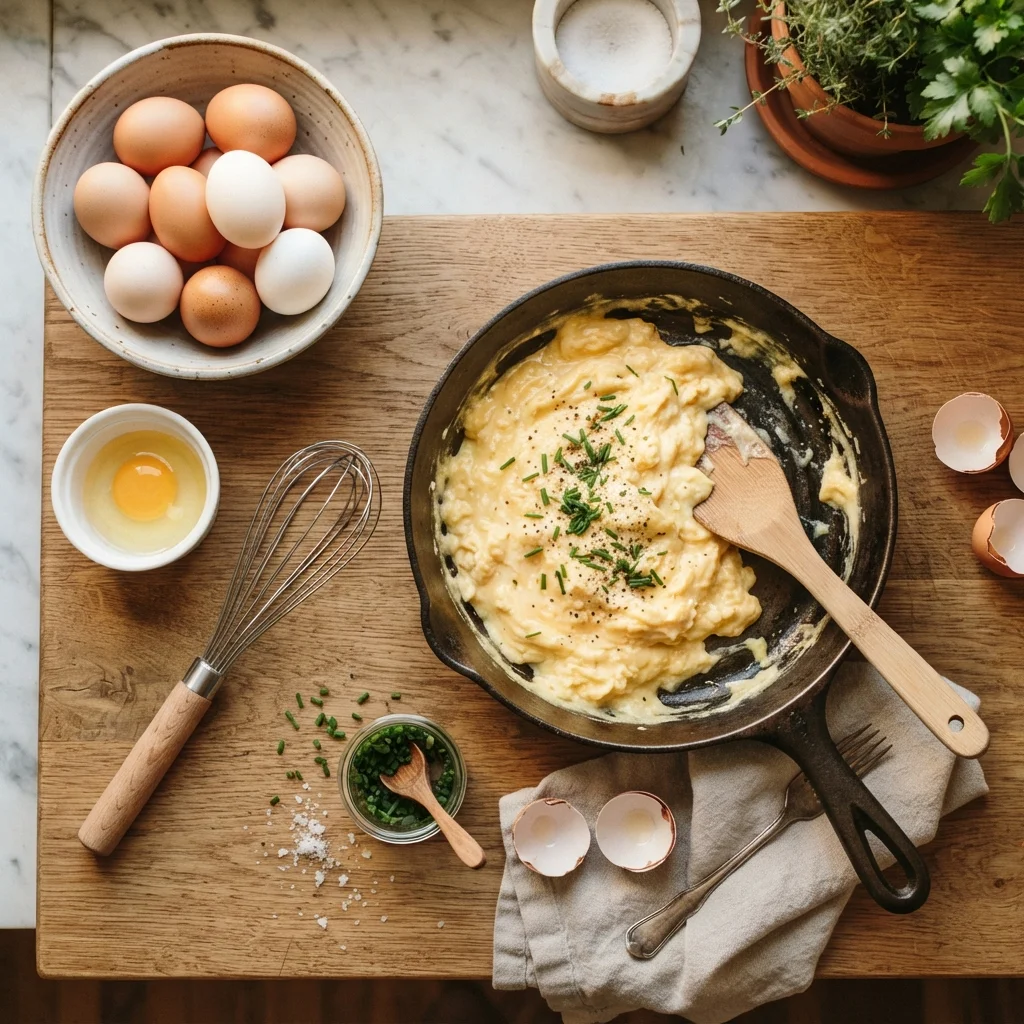
For the creamiest scrambled eggs, pull the pan off heat while the eggs still look underdone. Residual heat finishes the job without overcooking.
Eggs continue cooking after the heat source is removed. Accounting for carryover cooking is the single most reliable way to avoid rubbery scrambled eggs.
Add a pinch of cream of tartar when whipping egg whites — it stabilizes the foam and helps it hold stiff peaks longer without weeping.
Cream of tartar is mildly acidic and helps denature egg proteins more uniformly, resulting in a more stable meringue or soufflé base.
Cooking Methods: From Scrambled to Poached
Heat is everything with eggs. A few degrees too high and a perfect scramble turns rubbery; a minute too long and a poached egg runs dry. Here's a quick orientation to the core methods:
- Scrambled
- Low, slow heat with constant movement produces the creamiest curds. High heat gives a drier, more cohesive texture. Either is valid — it depends on your preference.
- Fried
- Over-easy, over-medium, over-hard, or sunny-side up — the difference is entirely how long the yolk cooks. A lid on the pan can steam the white firm without flipping.
- Poached
- Slide a very fresh egg into barely simmering water (not a rolling boil) with a splash of vinegar to help the white cohere. The vinegar lowers the pH and encourages the proteins to set quickly.
- Hard- or soft-boiled
- Cold-start or hot-start methods both work; what matters is timing and an ice-bath stop. Six minutes from boiling yields a jammy, custard-like yolk. Twelve minutes produces a fully set yolk.
- Baked (shirred)
- Eggs cracked into a buttered ramekin and baked at moderate heat until just set — a hands-off method that scales easily for a crowd.
Our kitchen readiness checklist is a useful companion here — having the right pan and the right heat source makes a real difference in egg cookery.
The Pan Matters More Than You Think
For fried and scrambled eggs, a well-seasoned cast-iron skillet or a quality nonstick pan over medium-low heat is your best tool. High heat in a thin pan creates hot spots that brown the whites unevenly before the yolk has a chance to set. Investing in a reliable pan — and using it at the right temperature — solves most common egg problems instantly.
Eggs as a Functional Ingredient
Beyond standalone preparations, eggs serve six key functional roles in cooking and baking:
- Binding — Eggs hold meatballs, veggie burgers, and meatloaf together as proteins set during cooking.
- Emulsifying — Yolk lecithin stabilizes oil-and-water mixtures like vinaigrettes, mayonnaise, and creamy pasta sauces.
- Leavening — Beaten egg whites incorporate air that expands in the oven, lifting cakes, soufflés, and meringues.
- Thickening — Slowly cooked yolks thicken custards, curds, and pastry cream without the starchy texture of flour.
- Glazing — An egg wash (beaten egg plus water or milk) brushed on pastry before baking creates a golden, glossy crust.
- Coating — Dredging in egg before breadcrumbs helps the crumb adhere during frying — essential for schnitzel, chicken cutlets, and croquettes.
Understanding these roles makes you a more flexible cook. When you know an egg is acting as an emulsifier in a sauce, you know why low heat matters — high heat causes the proteins to seize and the sauce to break. That kind of insight translates across recipes. Pair it with an understanding of overlooked flavor pairings and your cooking gets noticeably more interesting.
“The egg is to cuisine what the article is to grammar — small, seemingly simple, but present in everything and essential to structure.”
— Jacques Pépin, Chef, culinary educator, and author of numerous foundational cooking texts
Storage, Freshness, and Food Safety
In the United States, commercially sold eggs are washed, which removes a natural protective coating called the bloom. This makes refrigeration necessary — the USDA recommends storing eggs at or below 40°F. Store them in their original carton, not in the door, where temperature fluctuates most.
Never Leave Cracked Eggs at Room Temperature
Once an egg is cracked or removed from its shell, it should be used immediately or refrigerated in a covered container for no more than two days. Raw eggs left at room temperature for extended periods create conditions where bacterial growth — including Salmonella — can accelerate. When in doubt, discard and use a fresh egg.
A simple freshness test: place an egg in a bowl of cold water. Fresh eggs sink and lay flat. Older eggs tilt up or float as the air cell inside expands over time. Floating doesn't necessarily mean an egg is spoiled, but it warrants a sniff test before use.
As noted above, older eggs are actually preferable for hard-boiling because the slightly larger air pocket makes the shell easier to peel. Very fresh eggs can stick stubbornly to the inner membrane.
Nutrition at a Glance
One large egg contains roughly 70 calories, 6 grams of protein, 5 grams of fat, and less than 1 gram of carbohydrate. The yolk holds nearly all of the fat-soluble vitamins — A, D, E, and K — along with choline, a nutrient important for brain function that many Americans don't get enough of.
Dietary guidance on eggs has shifted over the decades. Current thinking from major nutrition bodies generally considers moderate egg consumption — around one per day — appropriate for healthy adults, though individual health contexts vary. For personalized dietary guidance, consult a registered dietitian. Our nutrition basics hub is a good place to explore general eating principles further.
Egg Consumption and Individual Health
People managing cardiovascular conditions, diabetes, or elevated cholesterol should discuss egg intake with a healthcare provider or registered dietitian. General population guidance does not account for individual risk factors, and what's appropriate varies by person. This article provides general information only — it is not personalized dietary advice.
Eggs pair nutritionally with a wide range of foods. A well-stocked pantry means you'll almost always have something to serve alongside them — whether that's whole-grain toast, sautéed greens, or a handful of herbs.
This article is for general informational purposes only and does not constitute medical or dietary advice. Consult a qualified healthcare or nutrition professional for guidance tailored to your individual health needs.