
The Placard, Not the Tire: Where to Find Your Correct PSI
One of the most persistent misconceptions in tire care is reading the pressure number off the tire sidewall. That figure — often printed in small text near the bead — is the maximum pressure the tire can physically contain, not the pressure your car needs. Running tires at that number can actually be dangerous.
The correct inflation specification for your vehicle lives on the tire and loading information placard, typically affixed to the inside edge of the driver's door jamb. It accounts for your vehicle's weight, suspension geometry, and intended load. Some vehicles specify different pressures for front and rear tires, and many automakers adjust recommendations further when the vehicle is carrying a full load.
Keep that placard number in mind as your target. It's what all the guidance below is built around.
What Underinflation Actually Does to Your Car
Low tire pressure is the more common and more dangerous condition. When a tire lacks adequate air, its sidewalls flex more than designed with each rotation. That excess flexing generates heat — and heat is a primary cause of tire failure, including blowouts at highway speeds.
Beyond the blowout risk, an underinflated tire's contact patch widens and deforms unevenly. The outer edges of the tread carry disproportionate load, which accelerates wear on those edges and shortens overall tire life. Handling becomes sluggish, and steering response degrades noticeably — something drivers often attribute to road conditions rather than their tires.
Braking is also affected. A deformed contact patch reduces the consistency of grip, which can extend stopping distances. For reference on how tire condition interacts with braking systems, see our guide to brake maintenance.
Check Pressure Before You Drive
Always measure tire pressure when the tires are cold — meaning the vehicle has been parked for at least three hours or driven fewer than a mile at low speed. Driving heats the air inside the tire and raises pressure artificially, which can make an underinflated tire look fine. Morning checks before your first drive give the most accurate reading.
Overinflation: The Less-Obvious Hazard
Drivers who overinflate — sometimes trying to maximize fuel economy — create a different set of problems. An overinflated tire becomes rigid and reduces its effective contact patch. Less rubber touching the road means less traction, especially in wet conditions.
The center of the tread takes on most of the load, causing rapid center-tread wear while the outer edges remain relatively unworn. The tire also transmits more road shock directly to the suspension, which can accelerate wear on suspension components over time.
Handling in an overinflated tire feels artificially firm and can become unpredictable when cornering quickly. The tire has less ability to conform to road surface irregularities, reducing grip at the very moments when you need it most.
~1 PSI
Pressure lost per 10°F temperature drop
This relationship between temperature and tire pressure is a well-established principle of gas physics and is cited by the National Highway Traffic Safety Administration (NHTSA).
25%
Pressure drop needed to trigger TPMS warning
U.S. federal regulations set the TPMS alert threshold at approximately 25% below recommended inflation, per NHTSA safety standards.
~0.5%
Fuel economy gained per PSI increase (to correct level)
The U.S. Department of Energy estimates fuel economy improves by roughly 0.5% for each PSI tires are brought up to the correct level from underinflation.
Temperature, TPMS, and the Limits of Dashboard Warnings
Tire pressure is not static. Air expands as it warms and contracts as it cools — a tire inflated properly on a warm afternoon can read 4–6 PSI lower on a cold winter morning. This is why the industry standard is to measure cold inflation pressure: before the vehicle has been driven, or within the first mile at low speed.
Since 2008, federal regulations have required all new passenger vehicles sold in the U.S. to include a Tire Pressure Monitoring System (TPMS). The dashboard warning light activates when pressure falls roughly 25% below the recommended level. That threshold means a tire can be meaningfully underinflated — affecting handling and wear — without ever triggering the light. TPMS is a useful safety backstop, not a substitute for regular manual checks.
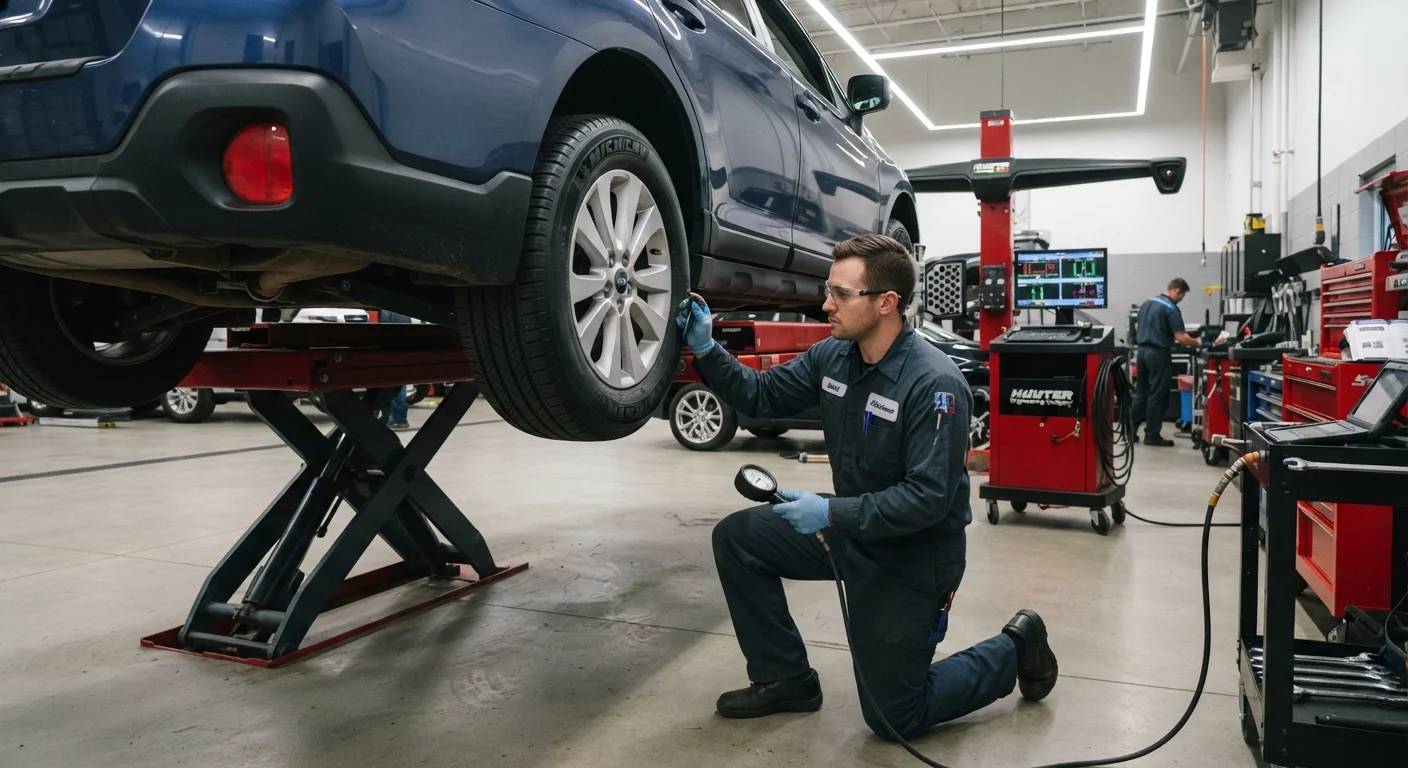
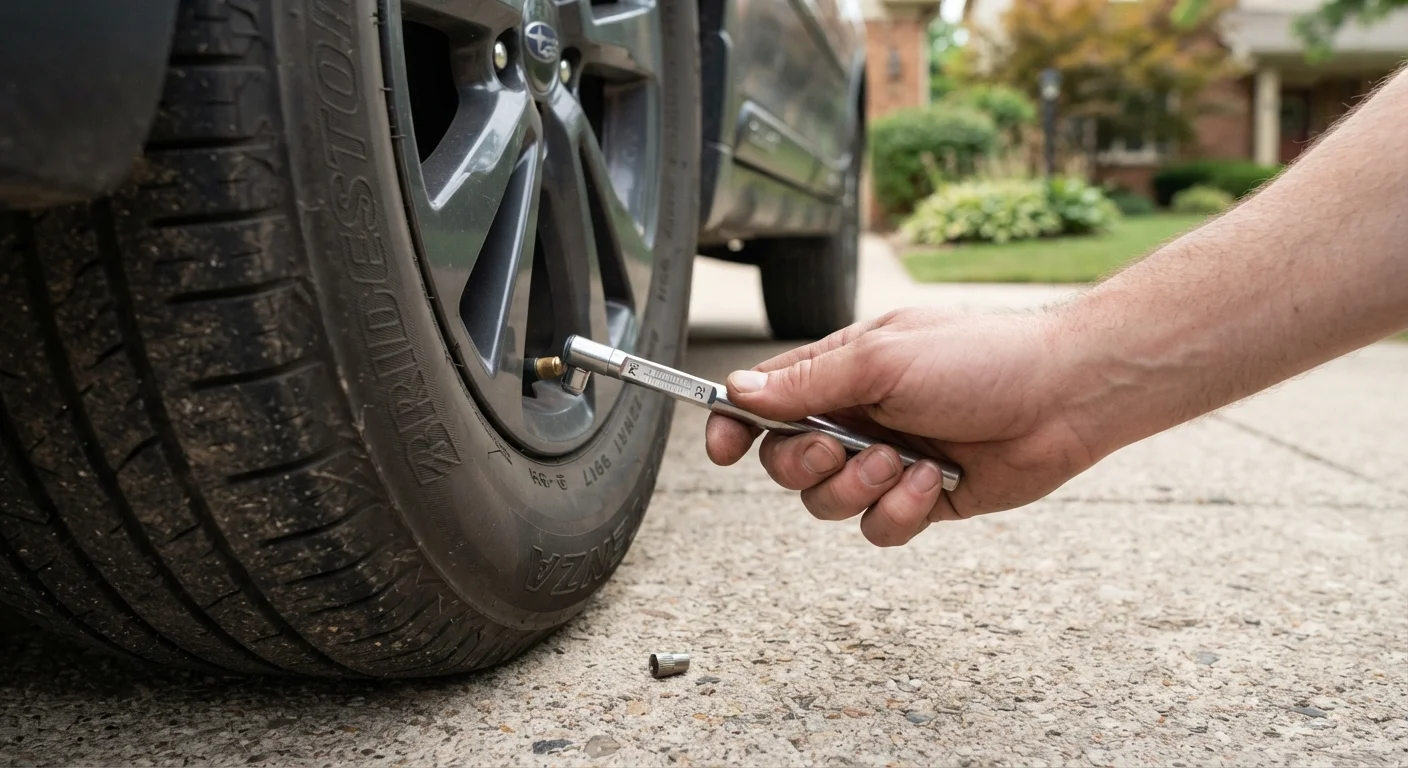
A quality dial or digital gauge is inexpensive and accurate. Stick-type gauges can be inconsistent. Check all four tires plus the spare if your vehicle has one. For context on where tire pressure fits into a broader maintenance schedule, see routine maintenance your car needs and when.
How Tire Pressure Connects to Long-Term Tire Health
Proper inflation works in tandem with rotation, balancing, and alignment to determine how long a set of tires lasts. Pressure that drifts chronically low causes uneven wear patterns that no amount of rotation can fully correct. Understanding the full picture of tire care is worth the time — our article on tire rotation, balancing, and alignment explains how these services work together.
A practical habit: check all four tires on the first of each month. It takes less than two minutes with a gauge, and the payoff — in tread life, fuel efficiency, predictable handling, and reduced blowout risk — is substantial. Tire pressure is one of the few maintenance tasks that costs nothing to perform correctly and pays dividends across nearly every dimension of vehicle operation.
Nitrogen vs. Air: A Common Question
Some tire shops offer nitrogen inflation, which maintains more stable pressure across temperature swings because nitrogen molecules are larger and less permeable than oxygen. While there is a measurable benefit, properly maintained air-inflated tires perform well for the vast majority of drivers. The most important factor is checking pressure regularly — the gas used matters far less than consistent monitoring.