
Why Social Trust Matters — and Why It's Misunderstood
Social trust — sometimes called generalized trust — refers to the basic confidence people extend to strangers, neighbors, and civic institutions. It's the quiet assumption behind leaving a package on a porch, letting a child walk to school, or expecting a government form to be processed honestly. When trust is high, societies function with less friction. When it erodes, everyday interactions carry more suspicion, more cost, and more stress.
But public conversation about trust in America is riddled with oversimplifications. Some voices declare trust is in freefall; others insist it was never as strong as nostalgia suggests. The actual research, drawn from decades of survey data and sociological study, tells a more layered story — one where geography, income, race, age, and civic life all play meaningful roles. Understanding what the evidence actually says helps us think more clearly about the communities we live in and the ones we want to build.
For a closer look at how community itself functions differently across American settings, see our exploration of suburban, urban, and rural community life.
Common Myths — and What the Data Actually Shows
Polling organizations including the Pew Research Center and the General Social Survey (GSS) have tracked social trust for decades. Their findings consistently challenge several popular assumptions about where Americans stand relative to one another and their institutions.
Myth
Americans today trust each other less than any previous generation — trust has never been lower.
Fact
Trust has declined from mid-20th-century peaks, but the decline is gradual and uneven, not a sudden collapse, and some local and interpersonal trust measures remain relatively stable.
Long-running surveys like the GSS show that the share of Americans agreeing that "most people can be trusted" fell from roughly half in the 1970s to around a third in more recent decades. That is a real and meaningful shift. However, researchers caution against treating this as a uniform collapse. Trust in close social networks — family, friends, coworkers — has remained more stable. What has declined most sharply is generalized trust in strangers and institutions, a distinction that matters when interpreting headlines.
Myth
Low social trust is a uniquely American problem driven by American culture.
Fact
Declining generalized trust is a trend observed across many wealthy democracies, though the degree and speed vary by country.
Comparative data from organizations like the OECD and World Values Survey show that trust has declined in numerous high-income countries over recent decades. The United States scores lower than Scandinavian nations — which consistently rank among the highest-trust societies globally — but it is not an outlier among similarly diverse, unequal, or large nations. Researchers generally attribute international variation to institutional quality, economic equality, and social homogeneity rather than to any single country's cultural character.
Myth
Institutional trust and interpersonal trust are essentially the same thing — if you distrust the government, you distrust your neighbors.
Fact
Trust in institutions and trust in fellow individuals are distinct constructs that do not move in lockstep and are shaped by different factors.
Pew Research Center surveys have consistently found that Americans can hold high trust in their immediate neighbors while expressing deep skepticism about Congress, the media, or large corporations. The reverse is also possible. Researchers treat these as separate dimensions: institutional trust is about confidence in systems and organizations, while interpersonal trust is about confidence in people. Conflating them produces misleading conclusions about both.
Myth
Cities are low-trust environments while rural and suburban communities are high-trust ones.
Fact
Trust levels vary within urban, suburban, and rural areas based on factors like income, stability, and civic engagement — not geography alone.
While some research finds modestly higher generalized trust in smaller communities, the differences within geographic categories are often larger than the differences between them. A stable, economically mixed urban neighborhood may show higher trust than a rural area experiencing economic decline or population turnover. Researchers emphasize that community cohesion, shared public spaces, and local institutions matter more than the urban-rural label itself. For a fuller picture of how community functions across settings, see our overview of community life across American geographies.
Myth
There is nothing individuals can do about social trust — it is a macro-level phenomenon determined by history and policy.
Fact
Individual behaviors and local community actions have measurable effects on trust at the neighborhood and social-network level.
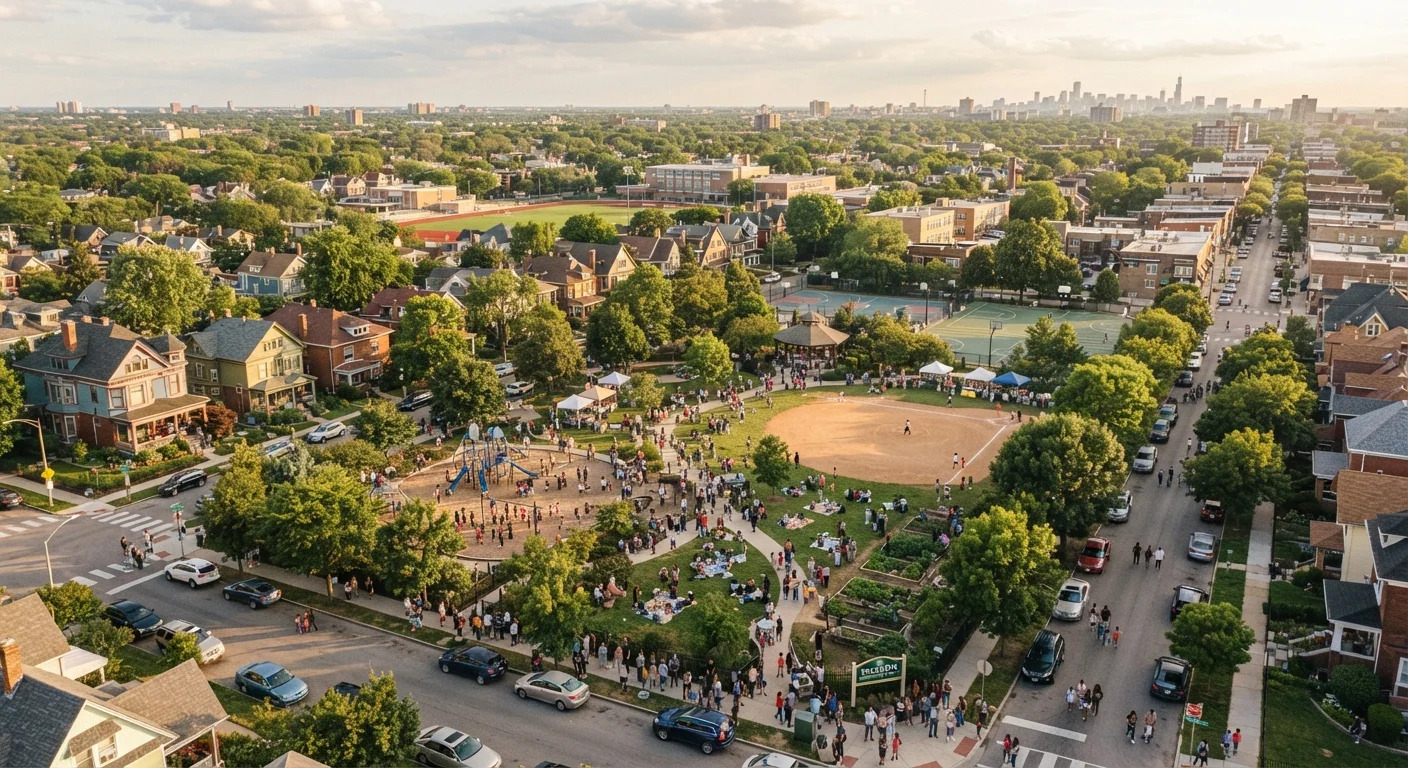
While large structural forces like inequality and institutional quality set a baseline, research on social capital — associated closely with the work of sociologists studying civic life — shows that local participation has real effects. Volunteering, attending community events, building relationships with neighbors, and engaging in local civic organizations are all associated with stronger local trust networks. These effects are modest at scale but meaningful at the community level. Misreading friendliness or social norms can also undermine trust-building; see our piece on what American social warmth actually signals for context.
~33%
Americans who say most people can be trusted
According to General Social Survey data analyzed over multiple decades, the share agreeing that most people can be trusted has hovered around one-third in recent years, down from roughly half in earlier decades.
Top 5
Factors linked to higher social trust
Economic equality, institutional quality, civic participation, neighborhood stability, and lower crime rates consistently emerge as the strongest predictors of higher trust in cross-national and domestic research.
64%
Americans trusting their neighbors "a lot" or "some"
Pew Research Center surveys have found that while generalized trust in strangers is low, a majority of Americans report meaningful trust in their own neighbors specifically.
What Actually Drives Trust — and What Weakens It
Research points to a consistent set of factors that strengthen or undermine social trust over time. Economic inequality is one of the most studied: communities with wider income gaps tend to report lower generalized trust, likely because inequality signals that people do not share the same risks or rewards. A large body of sociological work, including analyses drawing on GSS data, supports this association.
Civic participation — volunteering, attending local meetings, joining community organizations — is reliably linked to higher trust, and the relationship appears to run in both directions: trusting people participate more, and participation itself builds trust. The same is true of neighborhood stability; communities where people have lived longer and know more of their neighbors tend to show higher interpersonal trust scores.
Don't Confuse Media Perception With Community Reality
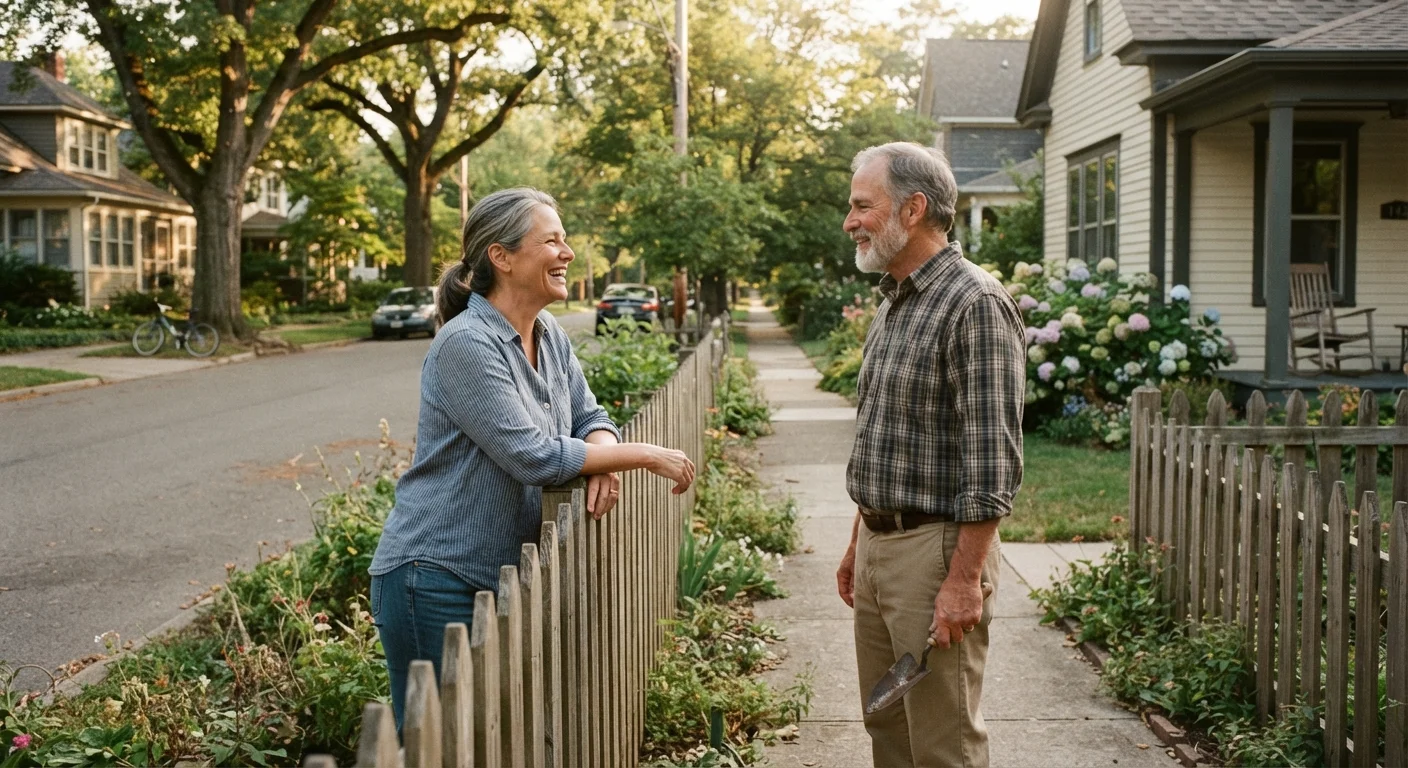
National surveys and local experience can diverge sharply. Americans consistently rate their own neighborhoods and personal social relationships more positively than they rate "society" in the abstract. Before concluding that trust in your community has collapsed, consider whether your perception is being shaped by national news cycles rather than local conditions. Direct neighborhood engagement is a more accurate signal than cable news coverage.
Media environment also matters. Research suggests that heavy consumption of conflict-driven news and social media is associated with lower perceptions of social trustworthiness, even when the underlying conditions of a community haven't changed. This doesn't mean the news causes distrust directly — the relationship is complex — but it does suggest that our information diet shapes how safe or unsafe we perceive the social world to be.
Trust is not just an abstract social metric. It has real consequences for health, civic engagement, economic cooperation, and individual well-being. Understanding its patterns is the first step toward participating in the conditions that support it. For a practical view of how trust operates at the neighborhood level, see our piece on what genuine neighbor relationships look like today.