

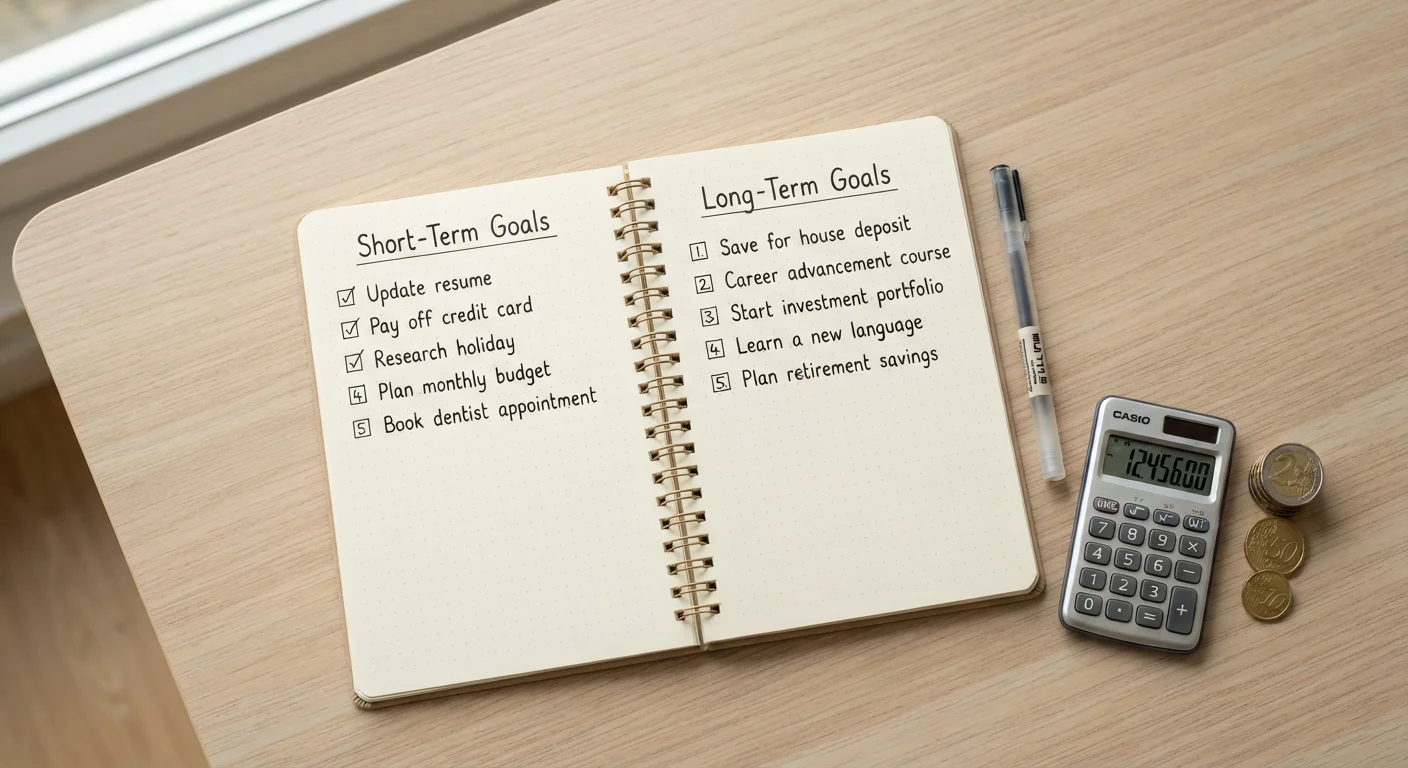
What Separates Short-Term From Long-Term Goals
At the most basic level, the difference is time. Short-term savings goals are targets you expect to reach within one to three years — an emergency fund, a car down payment, a vacation, or a holiday spending reserve. Long-term savings goals are targets that are three or more years out, often measured in decades: retirement, a home purchase, or funding a child's education.
The time horizon matters for more than just planning purposes. It directly shapes where you should keep the money, how much risk is appropriate, and how you measure progress. Money earmarked for a goal two years away shouldn't be in a volatile investment account — a market dip right before you need the funds could leave you short. Money for a goal thirty years out, on the other hand, is well-positioned to ride out market cycles and benefit from long-term growth.
Think of it this way: short-term savings prioritize preservation and accessibility, while long-term savings prioritize growth and compounding. Both are necessary. Neither alone is sufficient.
For a broader look at how these goals evolve across life stages, see savings milestones worth tracking at every stage.
How Each Approach Works in Practice
| Criterion | Short-Term Goals | Long-Term Goals |
|---|---|---|
| Typical time horizon | 1–3 years | 3–30+ years |
| Primary objective | Preservation & accessibility | Growth & compounding |
| Common account types | High-yield savings, money market | 401(k), IRA, 529, brokerage |
| Risk tolerance | Low — capital must be stable | Higher — time absorbs volatility |
| Examples | Emergency fund, car down payment | Retirement, home purchase, college |
| How progress is measured | Dollar amount saved toward target | Balance growth + contribution rate |
Short-term savings typically live in liquid, low-risk accounts — traditional savings accounts, high-yield savings accounts, or money market accounts. The goal is not to maximize returns but to ensure the money is there when you need it. Many households use sinking funds — dedicated pools for specific predictable expenses like car repairs or annual insurance premiums — as a practical short-term savings tool. Learn more about how they work in our overview of sinking funds.
Long-term savings, by contrast, are commonly held in tax-advantaged accounts such as 401(k)s, IRAs, or 529 plans (for education), or in taxable investment accounts. The extended time horizon allows for exposure to assets that carry more short-term volatility but offer meaningfully higher expected returns over many years. The key ingredient is time in the market, not timing the market.
One practical framework: automate a fixed contribution to your long-term account each pay period — even a modest amount — and separately automate a contribution to whichever short-term goal is currently your priority. This way, both goals receive consistent attention without requiring active decision-making each month.
The Risk of Prioritizing One Over the Other
A common mistake is treating short-term and long-term savings as competing rather than parallel efforts. Focusing exclusively on near-term goals can mean delaying retirement contributions by years — a cost that's difficult to recover because compounding rewards early starters disproportionately. On the other side, locking money into long-term vehicles while ignoring short-term needs often leads to debt: when an unexpected expense hits and there's no liquid cushion, many people turn to credit cards or loans.
~56%
Americans unable to cover a $1,000 emergency from savings
According to Bankrate's annual emergency savings report, a majority of U.S. adults would struggle to cover an unexpected $1,000 expense without borrowing.
10+ years
Compounding advantage of starting retirement savings at 25 vs. 35
Financial education resources consistently illustrate that a decade's head start on retirement saving can result in significantly larger final balances, even with identical contribution rates.
The solution is intentional sequencing. Financial educators often suggest a layered approach: first, contribute enough to a workplace retirement plan to capture any employer match (that's an immediate return on your contribution). Second, build a starter emergency fund — even $1,000 — to reduce reliance on credit for small emergencies. Third, expand the emergency fund to three to six months of essential expenses. From there, you can direct additional savings toward specific short- or long-term goals based on your timeline and circumstances.
If your savings progress has stalled despite intentions to follow through, the causes are often more structural than motivational. Our article on why savings goals keep stalling explores the common patterns — and how to address them without starting from scratch.
Building a Structure That Serves Both
One Goal at a Time Isn't Always Realistic
Many financial frameworks suggest tackling one goal fully before starting the next, but real life rarely cooperates. It's generally more practical — and psychologically sustainable — to make partial progress on multiple goals simultaneously. Even small, consistent contributions to a retirement account while building an emergency fund maintain the savings habit and capture time in the market. The key is intentionality: know what each dollar is for.
The practical foundation for balancing both types of goals is a clear naming and separation system. Keeping all savings in a single account makes it hard to track progress and easy to accidentally spend goal-specific money. Many savers benefit from using multiple labeled savings accounts — one for each active goal — which many banks now allow at no additional cost.
When setting contribution amounts, work backward from a target. If you want $3,600 for a vacation in 18 months, that's $200 per month. If you want $500,000 at retirement in 30 years, a financial calculator can help you determine what consistent monthly contribution, at a reasonable assumed growth rate, would be required — keeping in mind that actual returns vary and are not guaranteed.
For more on setting targets that reflect how you actually think and behave, see setting a savings goal you'll actually reach. And for a comparison of the account types best suited to different savings horizons, our overview of savings account types is a useful next step.
This article is for general informational and educational purposes only and does not constitute personalized financial advice. Consult a qualified financial professional before making decisions about your own savings or investment strategy.