

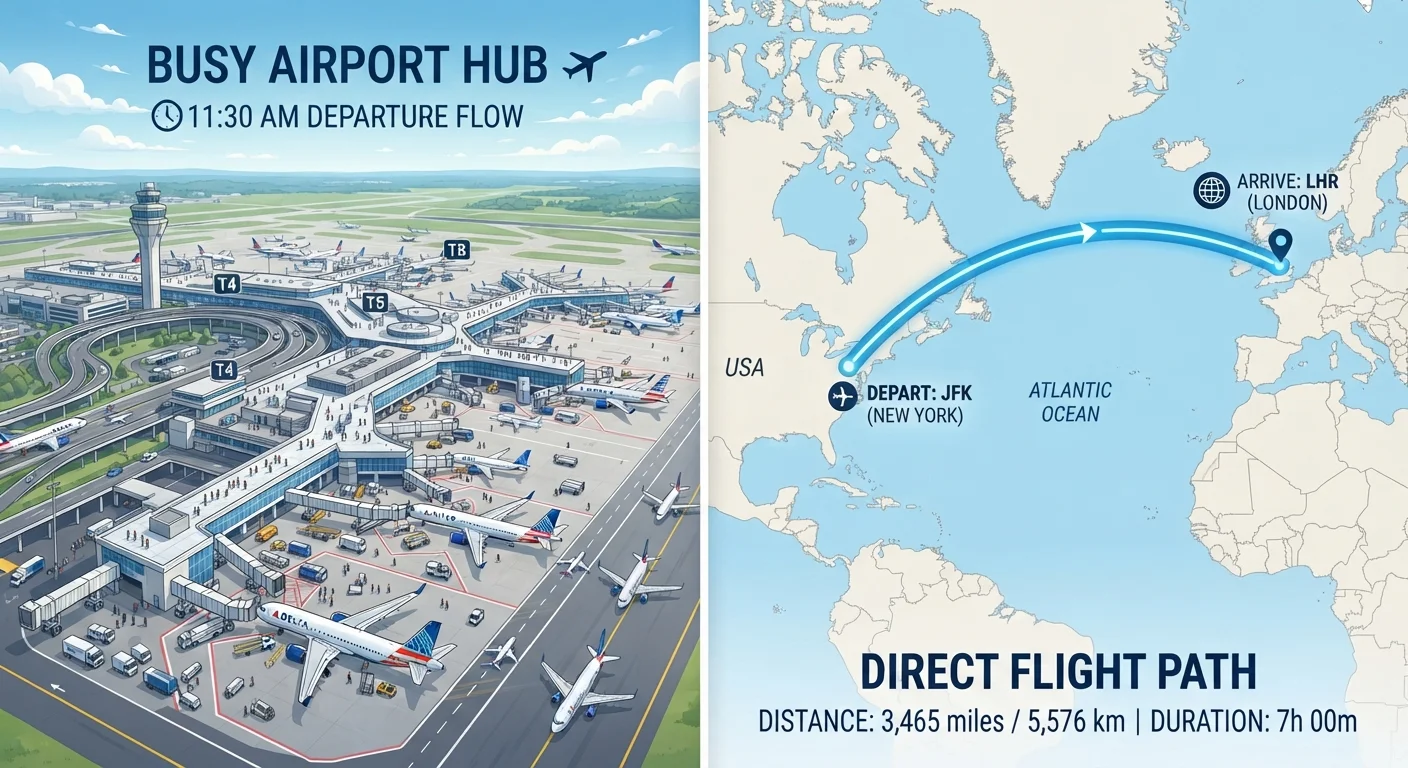
The Core Difference — and Why It Matters
A nonstop flight travels directly from origin to destination with no intermediate stops. A connecting flight involves at least one layover at a hub airport, where passengers change planes before continuing. (Note: a "direct" flight may share a flight number but still stop en route — it's not the same as nonstop.)
That distinction shapes almost every part of your travel day: total time in transit, exposure to delays, baggage handling, and cost. Neither approach is inherently superior — the better fit depends on your route, schedule, and priorities.
| Criterion | Nonstop Flights | Connecting Flights |
|---|---|---|
| Total travel time | Shortest possible | Longer — layover adds 1.5–4+ hours |
| Typical cost | Often higher | Often lower, varies by route |
| Missed connection risk | None | Present — higher with short layovers |
| Baggage reliability | Higher — single leg | Lower — more transfer points |
| Route availability | Limited to served city pairs | Reaches far more destinations |
| Comfort | One boarding, less disruption | Multiple boardings, terminal time |
| Flexibility for stopovers | None built in | Possible with extended layovers |
Time vs. Money: The Central Trade-Off
Nonstop flights consistently win on speed. Even a short layover adds at least 90 minutes to your journey; a longer connection can stretch a trip by four hours or more. That time has real value, particularly when you factor in arrival energy, work obligations, or a tight itinerary.
Connecting flights, however, often cost less — sometimes significantly. The price gap depends heavily on the route. On a high-frequency corridor like New York to Los Angeles, the difference may be modest. On a thinner route — say, a mid-sized U.S. city to a secondary European airport — a one-stop itinerary could be hundreds of dollars cheaper.
~30%
Typical fare gap on thin routes
Industry analysts generally observe that connecting fares on less-competitive routes can run 20–40% below comparable nonstop options, though this varies significantly by market and season.
1 in 5
Connecting passengers affected by delays
U.S. Department of Transportation data consistently shows a notable share of connecting itineraries are affected by irregular operations, underscoring the importance of buffer time at hubs.
When evaluating cost, think beyond the ticket price. A cheaper connecting fare may come with a redeye layover, an extra hotel night, or missed work — expenses that quietly close the gap. Thinking about travel costs as part of a broader savings picture? Our guide to short- and long-term savings goals can help you put travel spending in context.
Risk, Reliability, and What Can Go Wrong
The biggest operational risk with connecting itineraries is a missed connection. A delayed inbound flight, a long terminal walk, or a slow customs line can strand you at a hub for hours — or overnight. Airlines typically rebook passengers when the delay is their fault, but hotel vouchers aren't guaranteed, and the next available seat may be many hours away.
Layover Length Matters More Than You Think
Most travel planners suggest a minimum of 60–90 minutes for domestic connections and at least two hours for international ones — longer if you'll clear customs. A 45-minute layover may be technically possible, but a single gate change can make it unworkable. Building in buffer is especially important at large, complex hubs where concourse distances are significant.
Nonstop flights aren't immune to delays either, but they eliminate the compounding risk of a second flight. If your departure is late, you're still on a single plane headed to your destination — not racing through an unfamiliar airport.
Checked baggage adds another layer. With a connection, bags can be misrouted, especially if you're connecting on different airlines or with minimal time between flights. On nonstop routes, your bag travels the same arc you do.
When a Layover Can Actually Work in Your Favor
Not every layover is a burden. A longer connection — sometimes called an open-jaw or extended layover — can double as a mini destination. Some airports sit near genuinely interesting cities: Iceland's Keflavík serves Reykjavik; Singapore's Changi connects to the city in minutes. Airlines and individual countries sometimes offer visa-free transit programs that let you explore for a day or two.
If you're building a multi-city itinerary, a strategic layover can fold a second destination into your trip at little extra cost. Planning a European trip? Our comparison of flying vs. train travel in Europe explores how to think about hubs and city-to-city movement once you've landed.
The calculus shifts if you're on a long-haul international trip, where extra transit time compounds fatigue. On a 15-hour journey, adding a three-hour layover isn't a minor inconvenience.