
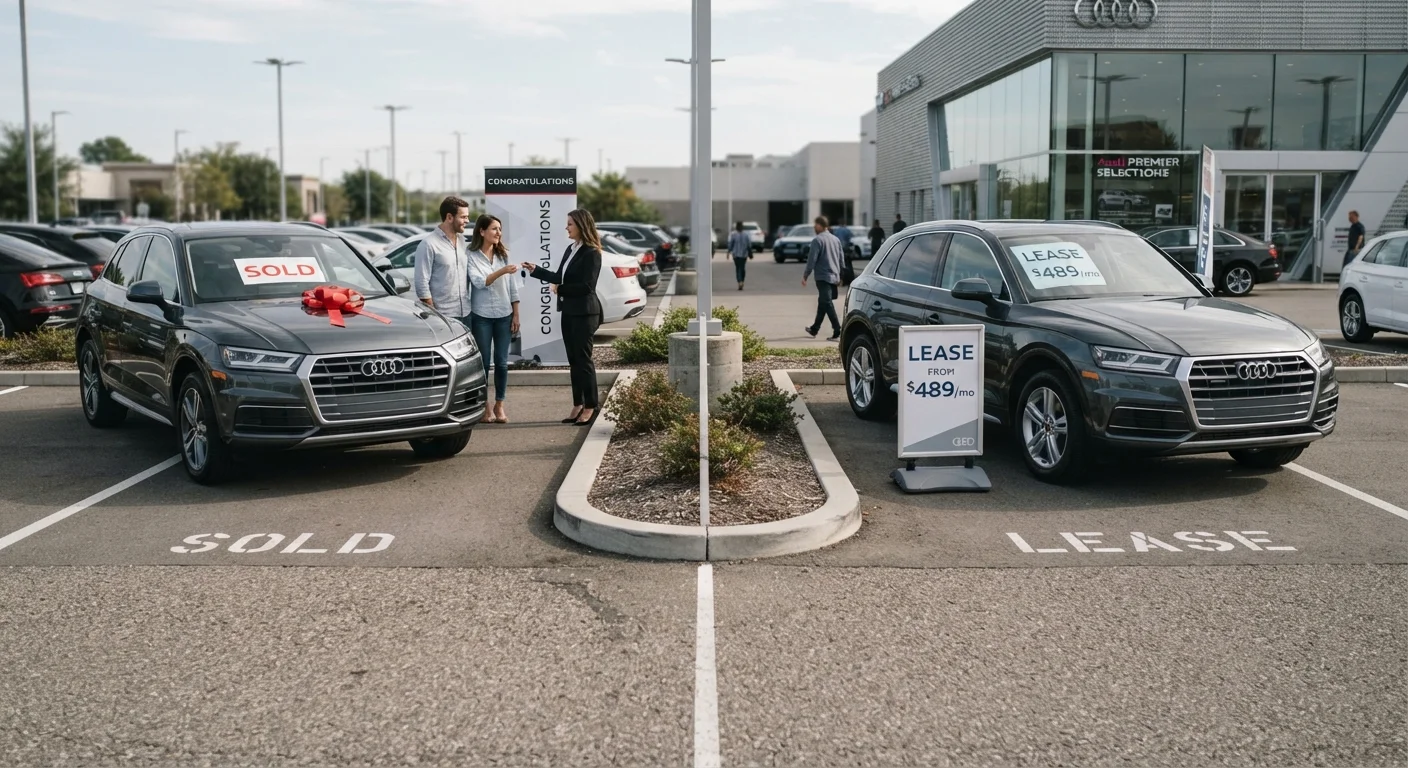
How Each Option Actually Works
When you buy a vehicle — whether with cash or a loan — you are purchasing ownership. If you finance, a lender pays the dealer and you repay the lender with interest over a set term, typically 48 to 72 months. Once the loan is retired, you hold the title outright.
When you lease, you are essentially renting the vehicle from a financing company for a fixed term, most commonly 24 to 36 months. Your monthly payment covers the vehicle's expected depreciation during that period plus a financing charge (called the money factor, the lease equivalent of an interest rate). At the end of the lease you return the car, buy it at a pre-set residual value, or roll into a new lease.
Understanding this distinction — ownership versus temporary use rights — is the foundation for comparing every other variable that follows. For a broader look at what vehicle ownership actually costs over time, see the full cost of owning a car.
| Criterion | Buying | Leasing |
|---|---|---|
| Ownership | Full ownership after loan payoff | No ownership; vehicle returned at term end |
| Monthly Payment | Higher (based on full vehicle price) | Lower (based on depreciation only) |
| Mileage Limits | None | Typically 10,000–15,000 miles/year |
| Upfront Costs | Down payment, taxes, fees | Cap cost reduction, first payment, fees |
| Long-Term Cost | Lower over 7+ years | Higher with continuous leasing |
| Flexibility to Exit | Sell or trade anytime | Early termination fees apply |
| Maintenance Risk | Owner bears all repair costs | Usually under warranty throughout term |
| Customisation | Allowed | Generally not permitted |
The Real Cost Comparison Over Time
Monthly lease payments are almost always lower than loan payments for the same vehicle — sometimes by several hundred dollars. That gap can feel decisive, but the comparison changes dramatically when you extend the time horizon.
A buyer who pays off a five-year loan and keeps the car for another five years essentially drives payment-free (aside from maintenance and insurance) for half the decade. A serial lessee, by contrast, carries a payment continuously. Over ten years, the cumulative cost of back-to-back leases typically exceeds the total cost of purchasing a comparable vehicle outright, even after accounting for the lessee's lower early payments.
~20%
First-year new car depreciation
Industry estimates consistently place new vehicle depreciation at 15–20% in the first year of ownership, according to automotive valuation sources.
$0.25/mi
Typical excess mileage fee
Most lease contracts charge between $0.15 and $0.30 per mile over the contracted annual allowance, adding up quickly for higher-mileage drivers.
36 months
Most common lease term length
The 36-month lease is the industry standard, aligning with the typical new-vehicle factory warranty period.
The calculus does shift for drivers who factor in repair costs on high-mileage owned vehicles. A leased car is almost always under warranty, reducing unexpected maintenance bills. For drivers who keep owned vehicles well past 100,000 miles, understanding upkeep demands matters — long-term ownership has its own financial case worth weighing separately.
Key Restrictions and Hidden Costs
Both options carry costs that do not appear in the advertised payment. Buyers face depreciation — a new vehicle typically loses 15–20% of its value in the first year alone — though that loss only matters financially if you sell. Lessees face a different set of constraints.
- Mileage caps: Most leases allow 10,000–15,000 miles per year. Excess mileage fees generally run $0.15–$0.30 per mile at contract end.
- Wear-and-tear charges: Lessees are billed for damage beyond normal use. Dents, stained interiors, and worn tires can generate end-of-term invoices.
- Early termination: Exiting a lease before term often carries substantial penalties — sometimes rivaling the remaining payments themselves.
- Disposition fees: When returning a leased vehicle without purchasing or re-leasing, many contracts include a disposition fee, typically $300–$500.
On the financing side, the source of your auto loan also affects total cost. Dealer financing versus bank or credit union loans can result in meaningfully different interest rates and terms.
Gap Insurance: A Often-Overlooked Factor
Whether buying or leasing, the balance you owe on a vehicle can exceed its market value, particularly early in the term. Gap insurance covers the difference if the vehicle is totaled or stolen before you've built sufficient equity or paid down enough of a lease. Many leases include this automatically; financed purchases typically do not. Verify your coverage before assuming it exists.
Which Path Fits Your Situation
No single answer applies universally. The right choice depends on how you use a vehicle, your financial priorities, and how much flexibility you need.
Buyers gain freedom: no mileage restrictions, no restrictions on modifications, and the ability to sell or trade whenever circumstances change. For those committed to long-term vehicle upkeep, ownership rewards patience and consistency.
Lessees gain predictability: fixed payments, warranty coverage throughout the term, and a natural exit point every two to three years. For drivers in professions where a newer vehicle matters, or those who simply prefer not to manage an aging car, leasing can be a rational choice.
Before signing either type of agreement, it is worth stress-testing your assumptions — particularly around annual mileage, how long you realistically keep vehicles, and whether you have the down payment or equity to make the numbers work. General financial planning resources, such as those covering budgeting basics, can help you frame where a car payment fits within your broader spending picture.
This article is for general informational and educational purposes only and does not constitute financial or legal advice. Consult a qualified financial professional before making significant financial decisions.