
Why Merging Trips Up Even Experienced Drivers
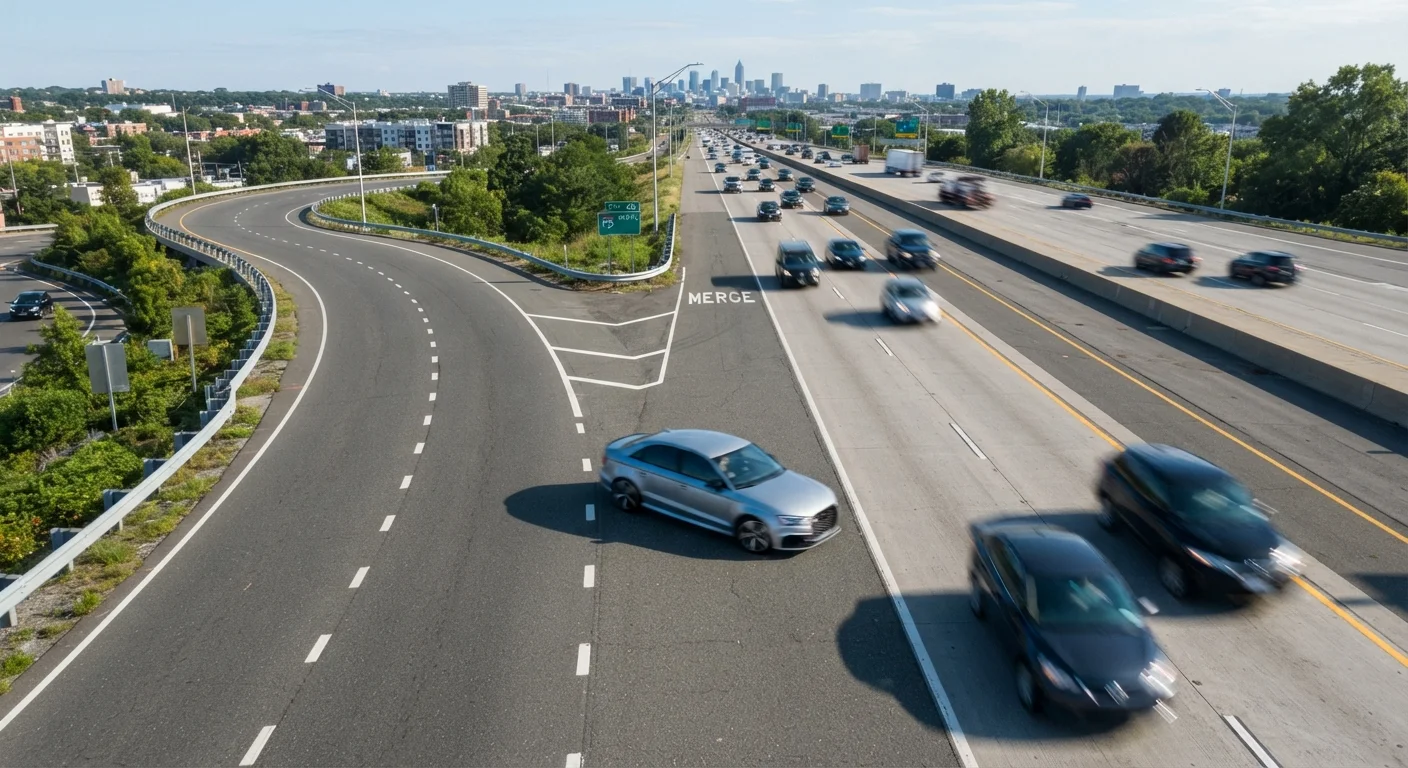
Highway merging sits at the intersection of speed, timing, and spatial judgment — and it demands all three simultaneously. Unlike most urban driving decisions, merging allows almost no time to reconsider. A driver has roughly 10 to 15 seconds from the point of entry onto an on-ramp to assess the traffic situation, match speed, identify a gap, signal, and execute the lane change.
Many drivers learned the basics of merging during licensing but never refined those skills under real freeway conditions. The result is a widespread collection of ingrained bad habits — habits that slow traffic, create near-misses, and occasionally cause serious crashes. Understanding what goes wrong, and why, is the first step to getting it right.
For a broader look at what separates skilled drivers from average ones, see what experienced drivers do differently.
Entering the highway well below freeway speed.
Why it happens: Drivers treat the on-ramp like a city street and brake or crawl while looking for a gap, not realizing the ramp is designed for acceleration.
Stopping completely on the on-ramp while waiting for a gap.
Why it happens: A misapplication of the "yield" instruction — drivers interpret yielding as stopping rather than timing their entry to an available gap.
Merging without checking blind spots or signaling.
Why it happens: Drivers focus entirely on the road ahead or on mirrors alone, missing vehicles in the left-rear blind zone, and skip signaling under time pressure.
Forcing a merge by nosing aggressively into traffic without a sufficient gap.
Why it happens: Anxiety about running out of ramp length causes drivers to commit before a safe gap is available, assuming other drivers will brake to accommodate them.
Merging into the middle or left lane rather than the rightmost travel lane.
Why it happens: Drivers aim for a visible gap wherever it appears, not understanding that a proper merge always targets the closest available travel lane first.
The Physics Behind a Proper Merge
Highway traffic operates on the principle of consistent speed and predictable movement. When a vehicle enters a lane at significantly lower speed than surrounding traffic, it creates a speed differential — the single most dangerous factor in rear-end and sideswipe collisions. The on-ramp is engineered specifically to give drivers the distance needed to close that gap.
~50%
Of merge-related crashes involve speed differential
Traffic engineering research consistently identifies speed mismatch between merging and through-lane vehicles as a primary factor in on-ramp collision risk.
300–500 ft
Typical on-ramp acceleration lane length
Federal Highway Administration design standards for acceleration lanes are intended to give drivers ample distance to match freeway speeds before lane entry.
Matching speed to surrounding traffic before merging reduces the disruption to the flow of vehicles and minimizes the risk of forcing abrupt braking in the lane you're entering. The on-ramp is not a place to wait and observe at low speed — it's an acceleration zone. Use it fully.
Blind spots are a significant complication in this moment. A driver checking mirrors for a gap may miss a vehicle in their left-rear blind zone. Building the habit of a quick shoulder check before committing to the merge is essential — and often overlooked. Our guide on blind spots every driver has covers where those zones are and how to compensate for them.
Never Stop on an Active On-Ramp
Coming to a full stop on a highway on-ramp — except in gridlocked traffic — places you and drivers behind you at serious risk. Vehicles approaching from behind expect you to be accelerating. A stopped vehicle on a ramp can be struck from behind before the following driver has time to react, especially at higher approach speeds.
Right-of-way rules matter here too. In the United States, merging vehicles must yield to traffic already traveling in the highway lane. Highway drivers are not legally required to move over for merging vehicles, though doing so when safe is considered courteous driving. Merging drivers who assume the lane will clear for them are misreading the law — and creating risk.