

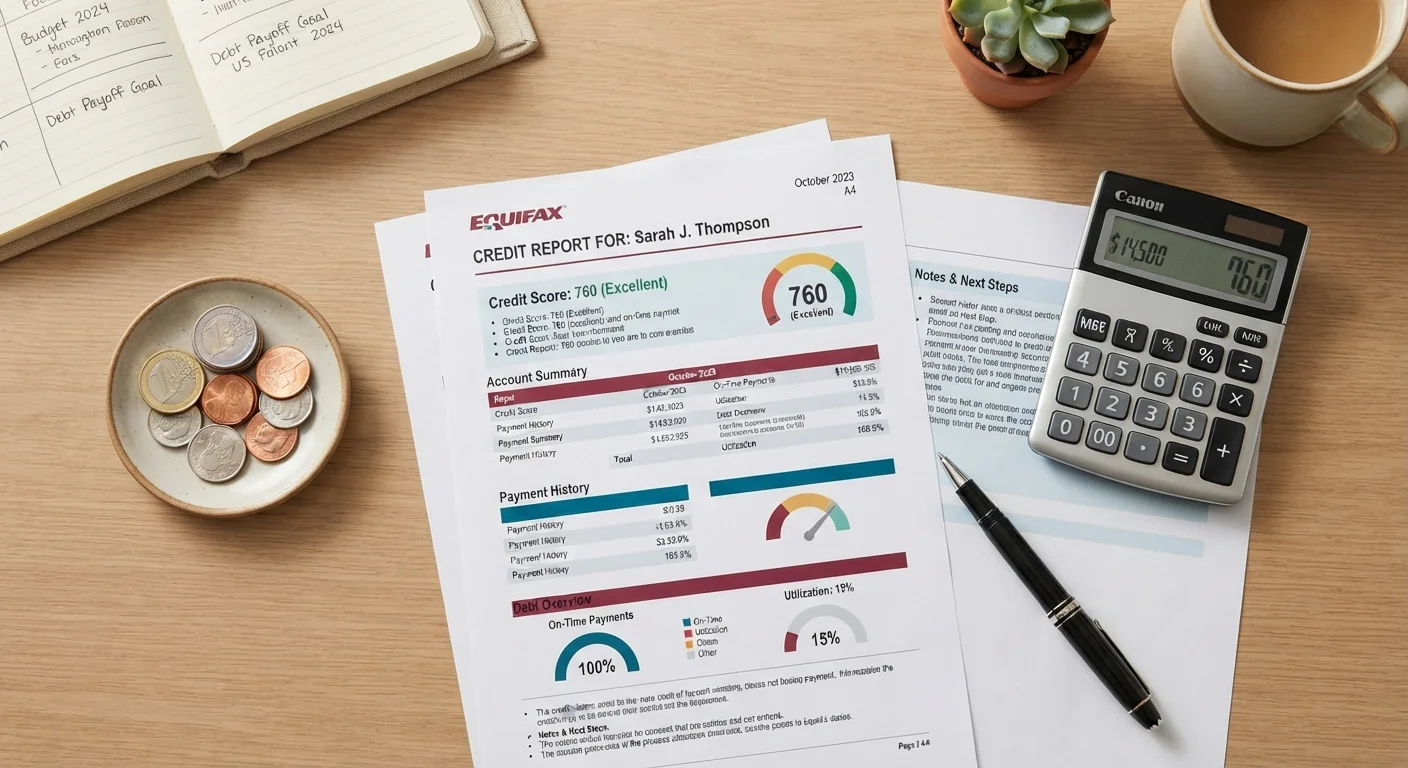
How the Credit System Works
The U.S. credit system is built on a simple idea: lenders want to predict how likely you are to repay borrowed money. To do that, they rely on data collected by three major credit bureaus — Equifax, Experian, and TransUnion. These bureaus gather payment history and account information from lenders, then compile it into a credit report.
Scoring companies — most notably FICO and VantageScore — then translate that raw report data into a three-digit number, typically ranging from 300 to 850. Higher scores signal lower risk to lenders, which generally translates to better loan terms and lower interest rates. Understanding this pipeline helps you see exactly where your score comes from and what you can influence.
~$104K
Average U.S. household debt
According to Federal Reserve data, the average American household carries significant debt across mortgages, auto loans, credit cards, and student loans.
716
Average U.S. FICO score
FICO's consumer data has consistently placed the national average credit score in the "good" range, though individual scores vary widely.
35%
Weight of payment history in FICO score
Payment history is the single largest factor in the FICO scoring model, underscoring why on-time payments matter most.
What Goes Into Your Credit Score
FICO scores — the most widely used scoring model — break down into five weighted categories:
- Payment history (35%): Whether you pay on time. A single missed payment can meaningfully lower your score.
- Amounts owed (30%): Your credit utilization ratio — the percentage of available revolving credit you're currently using. Staying below 30% is a widely recommended guideline.
- Length of credit history (15%): How long your accounts have been open. Older accounts generally help.
- Credit mix (10%): A healthy variety of account types — credit cards, installment loans, and others — can be a positive signal.
- New credit (10%): Recent applications for new credit trigger hard inquiries, which can cause a small, temporary dip in your score.
Set up autopay for at least the minimum payment on every account. Even one missed payment can undo months of score-building progress.
Payment history represents 35% of a FICO score, making it the single highest-impact behavior you can automate.
If you're close to a credit limit, consider making a mid-cycle payment before your statement closes — that's the balance typically reported to the bureaus.
Bureaus generally receive the balance on your statement date, so paying down before that date can reduce your reported utilization even if you pay in full each month.
VantageScore uses similar factors but weights them slightly differently. The practical takeaways, however, remain the same: pay on time, keep balances low, and avoid opening too many accounts at once.
Reading and Monitoring Your Credit Report
Your credit report and your credit score are not the same thing. The report is the underlying record; the score is derived from it. You're entitled to a free report from each bureau annually through AnnualCreditReport.com, the only federally authorized source.
When reviewing your report, focus on: account accuracy (correct balances and open/closed status), personal information, hard inquiries you don't recognize, and any collections or derogatory marks. Errors do occur — a 2021 study by the Federal Trade Commission found that a significant share of consumers identified at least one error on their reports.
If you spot an error, you have the right to dispute it directly with the bureau that issued the report. See our guide to reading your credit report for a section-by-section walkthrough.
How Often Can You Check Your Report?
Federally, you're entitled to one free report per bureau per year through AnnualCreditReport.com. However, many bureaus now offer free weekly reports as well. Checking your own report is a "soft inquiry" and does not affect your score.
Types of Debt and How They Differ
Not all debt behaves the same way, and understanding the distinction matters for both your credit and your repayment strategy.
- Revolving debt
- Credit cards and lines of credit. Balances can fluctuate month to month, and your utilization ratio directly affects your score.
- Installment debt
- Mortgages, auto loans, and student loans. These have fixed terms and set monthly payments. They contribute to credit mix but don't affect utilization the same way revolving debt does.
- Secured vs. unsecured debt
- Secured debt is backed by collateral (your home or car). If you default, the lender can claim that asset. Unsecured debt — like most credit cards — carries no collateral, which is one reason interest rates tend to be higher.
High-interest revolving debt is typically the most financially damaging to carry long-term. Understanding which debt costs you the most is the first step toward a smart payoff plan.
Proven Strategies for Paying Down Debt
Two structured methods dominate personal finance guidance on debt payoff:
The Debt Avalanche
List all debts by interest rate, highest to lowest. Make minimum payments on all accounts, then apply any extra money to the highest-rate debt first. Mathematically, this method minimizes the total interest you pay over time.
The Debt Snowball
List debts by balance, smallest to largest. Pay minimums everywhere, then throw extra money at the smallest balance. Once it's gone, roll that payment into the next debt. This method delivers quicker early wins, which research in behavioral economics suggests can help people stay motivated.
Match Your Method to Your Personality
If you're motivated by math and long-term savings, try the avalanche method. If you struggle with staying on track, the snowball's early wins may keep you going. Financial behavior research consistently shows that the method you'll actually follow through on is the one that works best for you.
Neither method is universally superior — the best approach is the one you'll stick with. Some people use a hybrid, tackling one small debt first for momentum, then switching to the avalanche method. What matters most is consistent, sustained effort over time.
If you're just starting to build your credit profile, our guide to building credit from scratch walks through how to establish credit responsibly before debt becomes a factor.
“The best debt payoff plan is the one that keeps you engaged. Motivation and consistency matter more than theoretical optimality.”
— Financial counseling practitioners, Widely held view among nonprofit credit counselors and behavioral finance researchers
Building or Rebuilding Your Credit Over Time
Credit improvement is almost always a slow process — but it is a predictable one. On-time payments, over many months, are the single most reliable lever. Here are additional approaches that can support that progress:
- Keep old accounts open when possible. Closing a card reduces available credit and can shorten your average account age.
- Request a credit limit increase on existing cards to lower your utilization ratio without carrying more debt.
- Become an authorized user on a family member's well-managed account to benefit from their payment history.
- Use a secured credit card or credit-builder loan if you have limited or damaged credit history. These tools are specifically designed to establish a track record.
Negative Marks Have a Time Limit
Most negative items — late payments, collections, charge-offs — remain on your credit report for seven years. Bankruptcies can remain for up to ten years. However, their impact on your score typically diminishes as time passes and positive history accumulates. You don't need a clean slate to start improving; you just need to begin.
Progress varies by individual, and there are no shortcuts that reliably override years of negative history overnight. Be cautious of any service that promises fast credit repair — legitimate credit counseling is generally nonprofit and transparent about what it can and cannot change.
This article is for general informational and educational purposes only and does not constitute personalized financial, credit, or legal advice. Consult a licensed financial professional or nonprofit credit counselor for guidance tailored to your specific circumstances.