

What a Credit Report Actually Contains
A credit report is a factual record compiled by credit bureaus — Equifax, Experian, and TransUnion — based on data submitted by your lenders and creditors. It is not a judgment or a score; it is raw data. That data, in turn, is what scoring models use to generate the number lenders see. Understanding the meaning behind credit score ranges is easier once you've seen the underlying report.
Reports are divided into four standard sections: personal information, accounts (sometimes called trade lines), public records, and inquiries. The accounts section is typically the longest and most consequential. Errors anywhere in the report can affect how lenders perceive you, which is why reviewing it systematically — not just skimming — matters.
Your Report Is Not Your Score
A credit report is a detailed record of your borrowing history — it does not include your credit score. Your score is calculated separately using the data in that report. Reviewing the report helps you understand what's feeding your score, but they are two distinct documents. To understand how scores are calculated from this data, see our breakdown of the five scoring factors.
Federal law gives you the right to one free report from each bureau per year through AnnualCreditReport.com. Some expanded access has been made available in recent years; check the site for current availability.
Only Use the Official Free Report Source
AnnualCreditReport.com is the federally mandated source for free credit reports under the Fair Credit Reporting Act (FCRA). Other sites advertising "free" reports may enroll you in paid subscriptions. Do not enter payment information to access your basic credit report.
What you will need
AnnualCreditReport.com
The federally authorized site to request free credit reports from all three major bureaus.
Highlighter or annotation tool
Mark entries that look unfamiliar, incorrect, or outdated as you work through the report.
Bureau dispute portals (Equifax, Experian, TransUnion)
Used to submit formal disputes online if you identify errors that need correction.
How to Read Your Report Step by Step
Work through your report section by section using the steps below. Don't try to evaluate everything at once — each section has a distinct purpose and different things to watch for. Errors are more common than many people realize; one study by the Federal Trade Commission found a notable share of consumers had at least one material error on a bureau report.
Review All Three Bureaus Separately
Not every lender reports to all three bureaus, so your reports from Equifax, Experian, and TransUnion may differ. Run through these steps for each report individually. Errors or unfamiliar accounts may appear on one but not the others.
Verify your personal information section
The first section of a credit report lists identifying details: your name (including variations), current and past addresses, date of birth, Social Security number (partially masked), and employer history. None of this data directly affects your score, but inaccuracies here can indicate mixed files — where another person's data has been merged with yours — or early signs of identity theft.
Check that every address listed is one you actually lived at. Flag any name variations you don't recognize.
Examine your accounts section closely
This is the most substantive section. It lists every credit account — credit cards, mortgages, auto loans, student loans — that has been reported to the bureau. For each account, you'll see: the creditor name, account type, date opened, credit limit or loan amount, current balance, payment history (often shown month-by-month), and account status (open, closed, or in collections).
Work through each account and confirm: (1) you recognize the creditor, (2) the account status is accurate, (3) no payments are marked late that you paid on time, and (4) balances are in a reasonable range relative to what you know.
Check the public records section
Public records on a credit report historically included bankruptcies, civil judgments, and tax liens. As of current bureau practices, only bankruptcies typically appear here — judgments and tax liens were largely removed in 2017 following a data accuracy initiative. If this section is empty on your report, that's normal for most consumers.
If a bankruptcy appears, verify the filing date and chapter type are correct. Chapter 7 bankruptcies stay on a report for up to 10 years; Chapter 13 for up to 7 years from the filing date.
Review the inquiries section
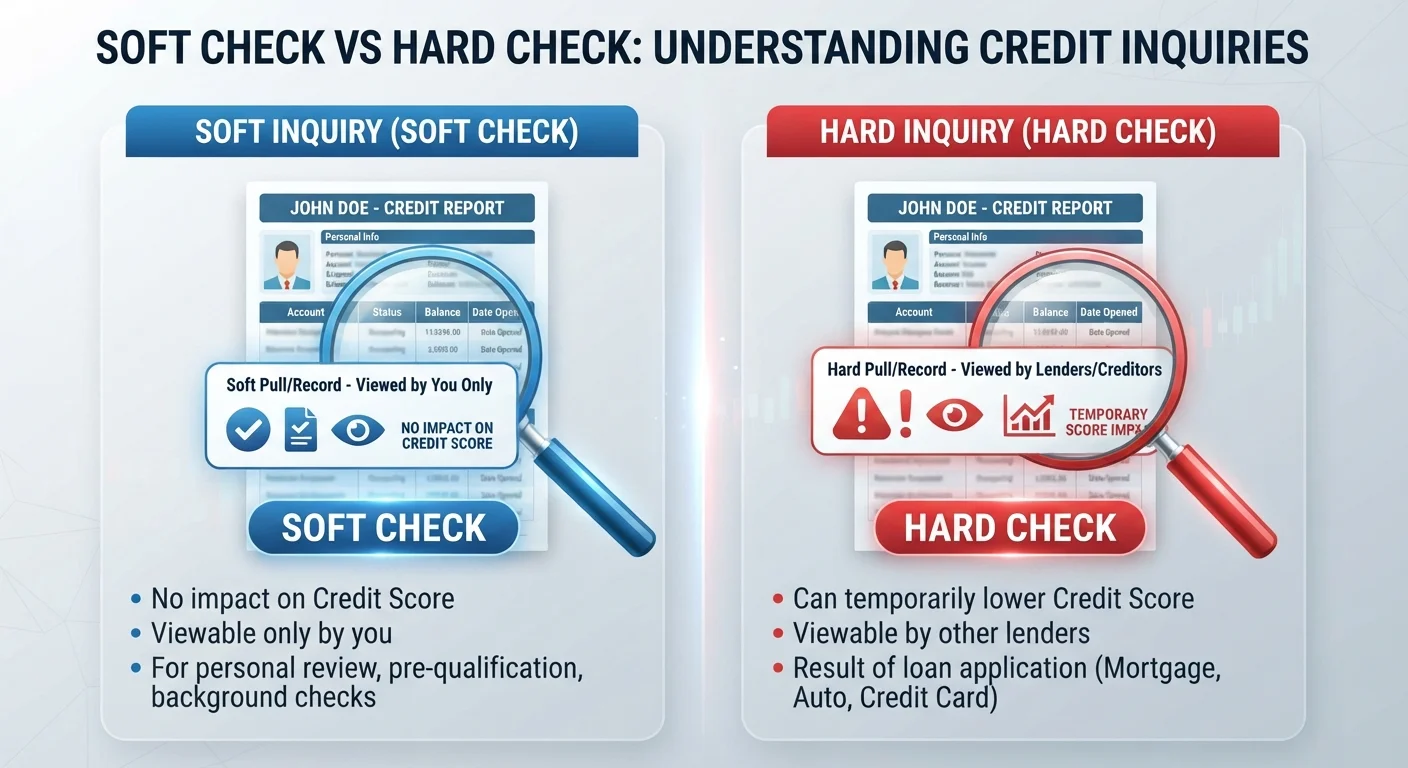
Inquiries are logged each time someone accesses your report. There are two types: hard inquiries (triggered when you apply for credit — a card, loan, or mortgage) and soft inquiries (background checks, pre-approval screenings, your own checks). Only hard inquiries affect your score. Our guide on hard vs. soft inquiries explains the difference in detail.
Look through the hard inquiries list. Each one should correspond to a credit application you actually made. An unfamiliar hard inquiry — especially several in a short period — warrants immediate follow-up, as it may indicate someone applied for credit in your name.
Flag errors and gather documentation
Before filing a dispute, compile your evidence. For a payment incorrectly marked late, gather bank statements, payment confirmation emails, or canceled checks. For an account you don't recognize, note the creditor name, account number (partial), and date opened so you can reference it clearly in your dispute letter.
Each bureau has its own online dispute portal, and disputes can also be submitted by mail. The FCRA requires bureaus to investigate most disputes within 30 days and notify you of the outcome in writing.
Set a schedule for future reviews
Reading your credit report isn't a one-time task. Accounts change, new inquiries appear, and errors can surface at any time. Building a routine — reviewing at least once a year, or before any major credit application — keeps you ahead of problems.
Before applying for a loan or card, it's worth doing a structured self-check. Our pre-application checklist walks through exactly what to confirm before you submit.
This article is for general informational and educational purposes only and does not constitute financial or legal advice. For questions specific to your financial situation, consider consulting a qualified financial adviser or credit counselor.