

What Each Type of Inquiry Actually Is
Every time someone accesses your credit file, it's recorded as an inquiry. But two very different categories of inquiry exist, and only one of them affects your credit score.
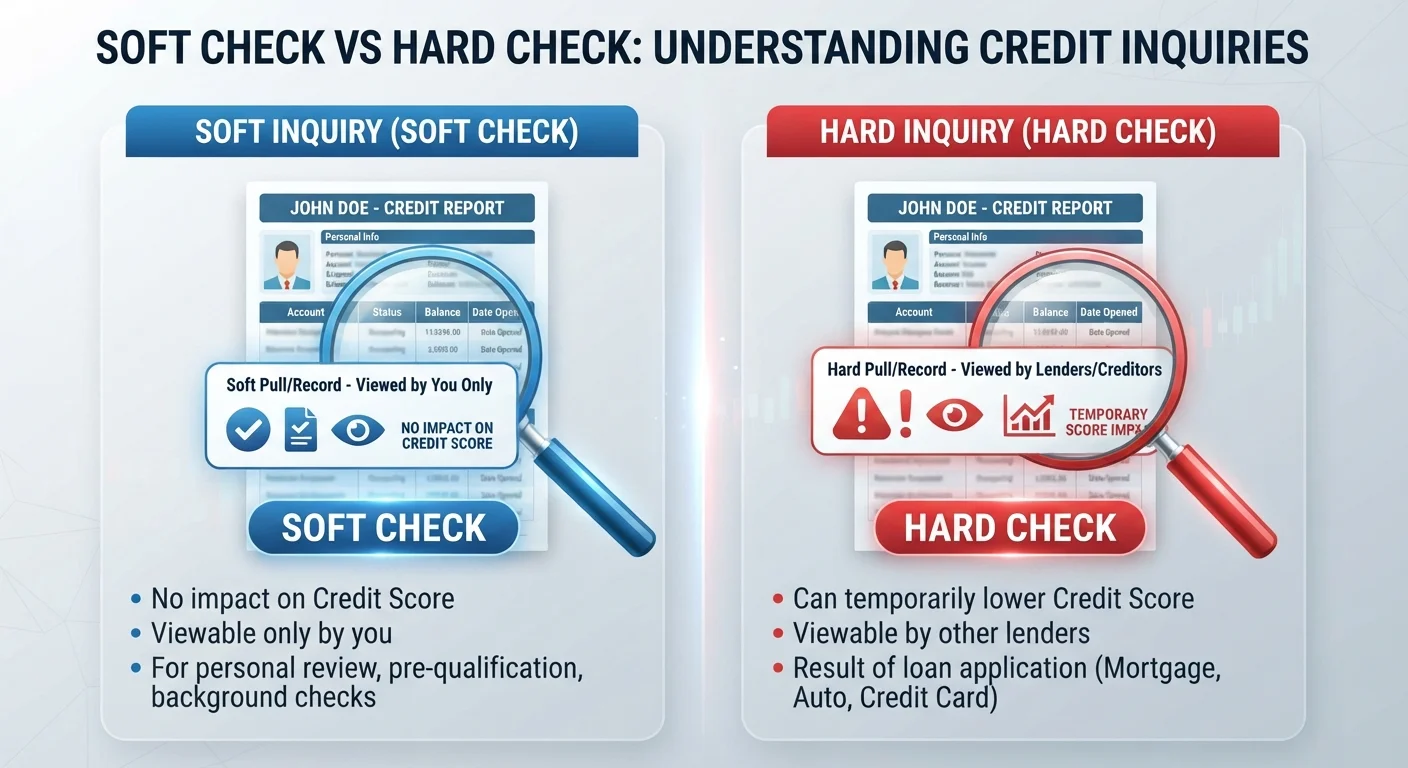
A hard inquiry (sometimes called a hard pull) happens when a lender, landlord, or creditor reviews your credit as part of a formal application decision. Examples include applying for a credit card, a car loan, a personal loan, or a mortgage. You must authorize a hard pull — lenders are legally required to obtain your permission before performing one under the Fair Credit Reporting Act (FCRA).
A soft inquiry (or soft pull) happens when your credit is accessed in a way that doesn't involve a lending decision on your behalf. Common examples include: checking your own credit score or report, a credit card company pre-screening you for a promotional offer, or an employer conducting a background check. Soft inquiries do not require your permission in all cases — for example, prescreened offers can be generated without you initiating anything.
The core distinction is simple: hard inquiries signal you may be taking on new debt; soft inquiries do not.
How Each Type Affects Your Credit Score
This is where the difference becomes financially meaningful.
Hard inquiries can temporarily lower your credit score. According to FICO, a single hard inquiry typically costs fewer than five points for most people — a modest dip for most consumers. However, the impact is more significant for people with shorter credit histories or fewer accounts. Hard inquiries stay on your credit report for two years, but their influence on your score generally fades after about 12 months.
Soft inquiries have zero effect on your credit score. They appear in a separate section of your credit report that's visible only to you — not to lenders reviewing your file. No matter how many soft pulls occur, your score remains unaffected.
| Criterion | Hard Inquiry | Soft Inquiry |
|---|---|---|
| Triggers | Formal credit application | Prequalification, self-check, background check |
| Affects credit score | Yes — temporarily | No |
| Typical score impact | Fewer than 5 points (for most) | Zero points |
| Stays on report | 2 years | Visible only to you; no lender impact |
| Your authorization required | Yes, always | Not always |
| Visible to lenders | Yes | No |
One nuance worth knowing: if you're actively shopping for a mortgage, auto loan, or student loan, most scoring models apply a rate-shopping window. FICO models typically group multiple hard inquiries of the same loan type within a 14- to 45-day window and count them as a single inquiry. This is designed to let consumers shop for the best rates without being penalized for comparison-shopping. For more on what these factors look like on paper, see how to read your credit report.
Common Scenarios and Which Inquiry Applies
Confusion often arises in everyday situations. Here's a quick breakdown:
- Prequalification vs. full application: Many credit card issuers and lenders offer prequalification using a soft pull. If you see an offer you like and submit a full application, that triggers a hard pull. Ask explicitly which type is being run before you proceed.
- Checking your own credit: Always a soft inquiry. AnnualCreditReport.com, your bank's credit score tool, and third-party monitoring services all use soft pulls.
- Employer background checks: Soft inquiries, and employers must obtain your written consent to access your report.
- Utilities and rental applications: These sometimes involve a hard pull — it varies by provider, so it's worth asking beforehand.
- Credit limit increases: May be a hard or soft pull depending on whether you request the increase or the issuer proactively offers it.
Rate-Shopping Is Protected by Scoring Models
If you're comparing mortgage or auto loan offers from multiple lenders, you don't need to avoid applying out of fear of multiple hard pulls. FICO scoring models generally treat several hard inquiries for the same loan type within a condensed window — typically 14 to 45 days depending on the model version — as a single inquiry. This protects consumers who are doing exactly what financial experts recommend: shopping around for the best terms.
Understanding when a hard inquiry might occur helps you time applications more strategically — particularly if you're preparing to apply for new credit in the near future.
Keeping Inquiries in Perspective
Hard inquiries are just one of several factors scoring models evaluate. Payment history and credit utilization each carry far more weight in most scoring formulas. A single hard inquiry is unlikely to derail an otherwise healthy credit profile.
That said, several hard inquiries in a short period — outside the rate-shopping window — can signal risk to lenders and cause a more noticeable score dip. Spacing out new credit applications when possible is a reasonable practice, especially if you have an important loan application on the horizon, such as a mortgage.
If you spot hard inquiries on your report that you didn't authorize, that's worth investigating promptly. Unauthorized inquiries can sometimes indicate identity theft or a reporting error, both of which you have the right to dispute with the credit bureaus. If you're exploring credit-building tools, understanding how these inquiries work can also inform decisions about secured versus unsecured credit cards.
This article is for general informational purposes only and does not constitute personalized financial or credit advice. For guidance specific to your situation, consider consulting a qualified financial professional.