
The Real Math Behind Minimum Payments
Credit card minimum payments seem manageable — often just $25 to $50 a month on a moderate balance. But that convenience comes at a steep price driven by how interest compounds over time.
Most credit cards calculate interest daily. Your annual percentage rate (APR) is divided by 365 to produce a daily periodic rate, which is then applied to whatever balance you're carrying. That means every day you carry a balance, more interest is added — and tomorrow's interest is calculated on a slightly larger number than today's.
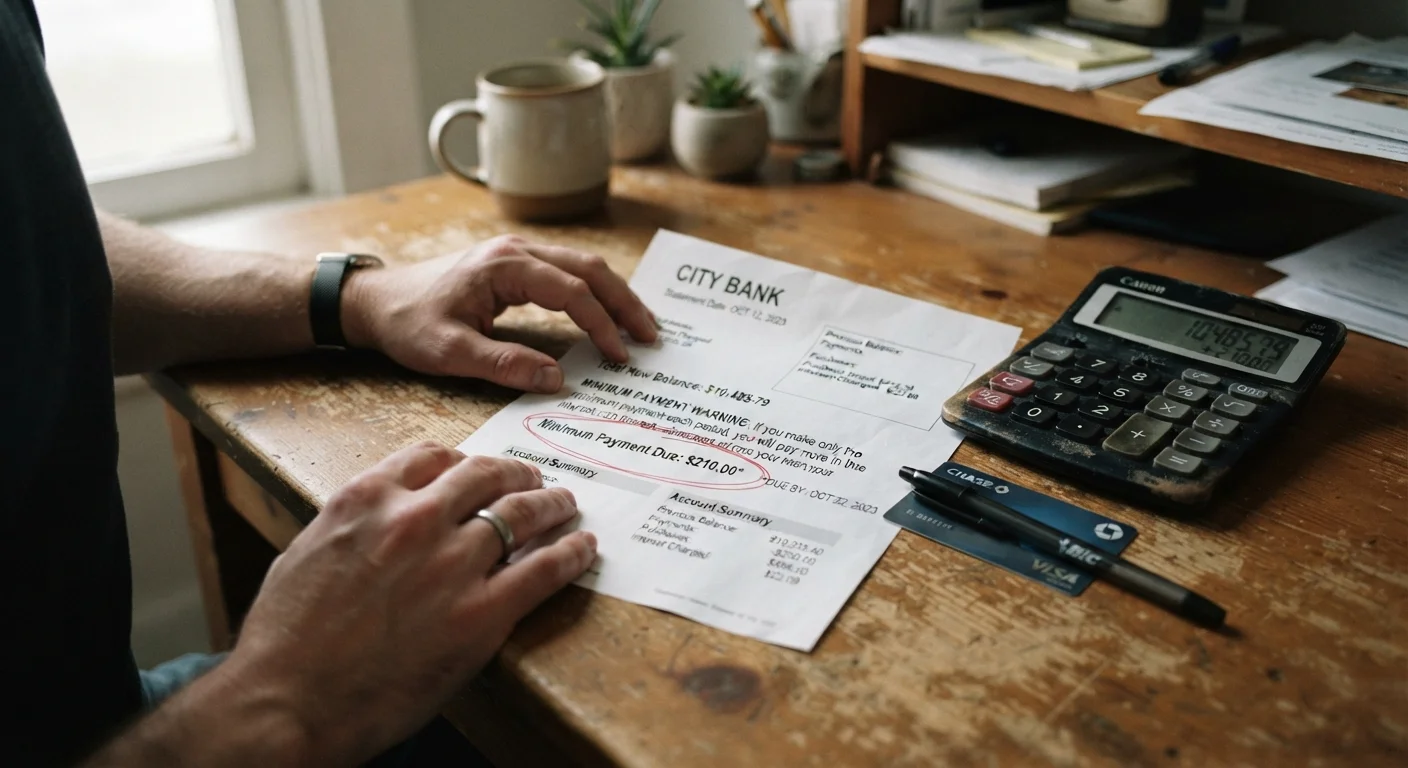
Consider a $3,000 balance on a card with a 20% APR. If you pay only the minimum (typically 1–2% of the balance or a set floor), your required payment starts around $60 and shrinks slightly each month as the balance does — but so does the portion reducing your principal. Early payments are largely absorbed by interest. According to CFPB educational resources, this repayment pace can stretch beyond a decade and cost more than the original balance in total interest charges.
10+ years
Time to pay off $3,000 at 20% APR on minimums
Consumer Financial Protection Bureau (CFPB) educational resources illustrate that minimum-only payments on a typical card balance can stretch repayment well beyond a decade.
~$1,000+
Extra interest paid versus a fixed accelerated payment
General amortization modeling shows that interest charges on a mid-size balance paid at minimum rates can exceed the original principal owed over the life of the debt.
This is why understanding the math — not just the monthly obligation — matters so much. For a broader look at credit misconceptions, see Credit Cards and Debt: Separating Myth from Reality.
This article provides general financial education and is not personalized financial advice. Consider speaking with a licensed financial professional about your specific situation.
Common Mistakes That Keep the Balance Growing
Understanding why minimum payments trap people requires looking honestly at the habits — often well-intentioned — that reinforce the cycle. The mistakes below are among the most common, and each one quietly extends the time it takes to become debt-free.
Treating the minimum payment as the intended payment amount.
Why it happens: Card statements present the minimum prominently, and paying it on time feels responsible. Many cardholders assume it's a reasonable repayment pace set by the lender.
Ignoring how daily compounding interest accelerates balance growth.
Why it happens: APR (annual percentage rate) sounds manageable as an annual figure, but most cards compound interest daily. This invisible daily accumulation is easy to overlook when you're focused on monthly billing cycles.
Making purchases on a card while only paying the minimum balance.
Why it happens: People often view available credit as available spending power, continuing to use a card for everyday expenses without realizing that new charges compound on top of an already-growing balance.
Not reallocating freed-up money after one debt is paid off.
Why it happens: When one card is finally paid off, the monthly cash that covered its minimum often drifts into general spending rather than being directed toward the next debt. This is sometimes called "lifestyle creep" in payoff strategies.
Avoiding these patterns is closely tied to responsible credit habits that hold up over time. Small, consistent behavioral changes compound in your favor just as surely as interest compounds against you.
Missing Payments Hurts More Than Minimums
While paying only the minimum is costly, missing a payment entirely triggers late fees, potential penalty APRs, and a negative mark on your credit report. If cash is extremely tight, paying at least the minimum on time is better than skipping — but treat it as a floor, never a goal. Habitual minimum-only payments quietly erode your financial position over months and years.
If your balances span multiple cards or lenders, you may also want to explore whether debt consolidation could simplify your payoff plan — though it carries its own trade-offs worth understanding before acting. Additionally, some debt-related habits can quietly affect your credit score in ways that surprise people; learn about actions that accidentally damage credit to avoid compounding the problem.
Minimum Payments Are Not Designed to Free You
Card issuers calculate minimum payments to keep accounts current — not to help cardholders get out of debt efficiently. These amounts are typically set at 1–2% of your outstanding balance or a flat dollar floor (often $25–$35), whichever is greater. At that pace, the majority of your payment goes toward interest, not principal. Always consult a licensed financial professional if you need personalized guidance on managing debt.