
Two Models of Belonging
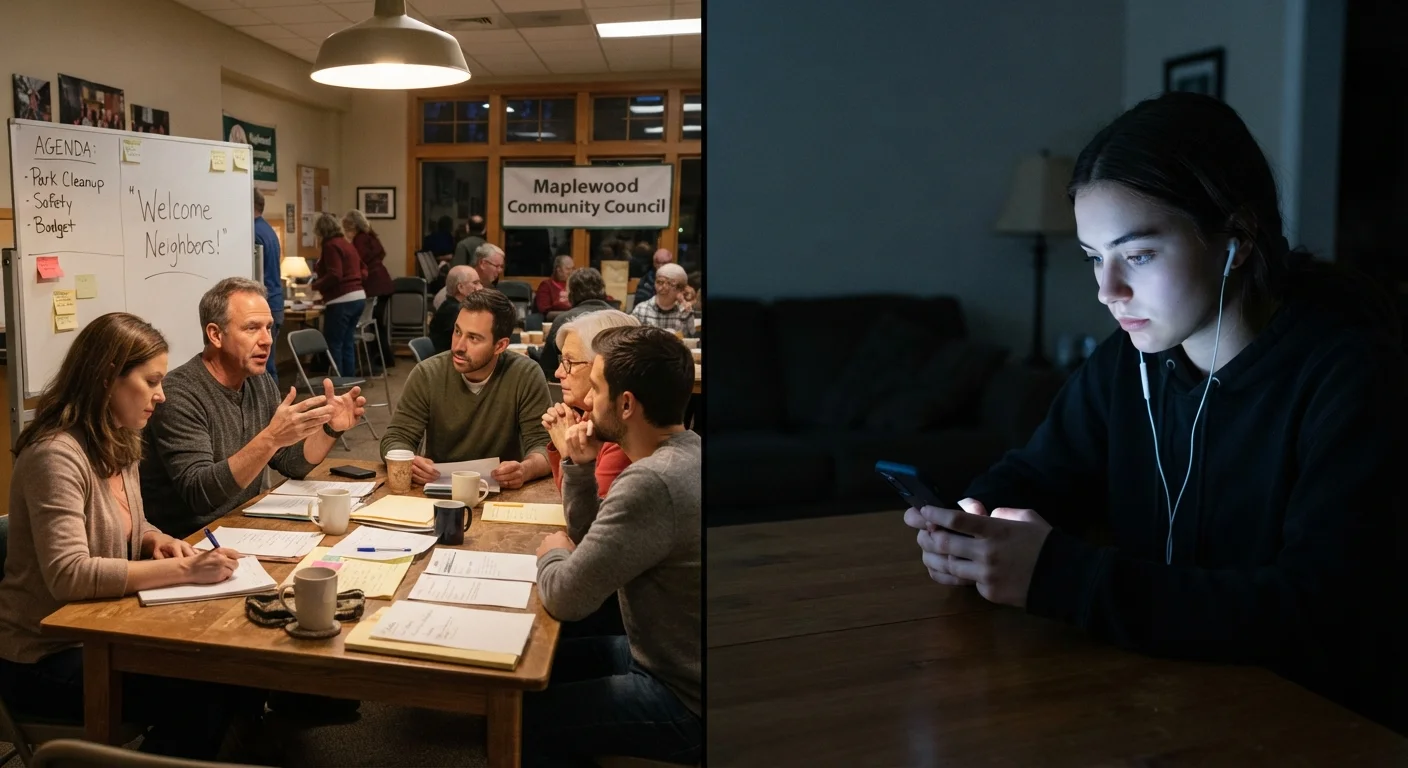
Americans have always found ways to organize around shared interests and shared geography. Today, two distinct models dominate everyday community life: online communities — digital groups built around platforms like Facebook Groups, Reddit, Nextdoor, or Discord — and neighborhood associations, the formalized, place-based civic organizations rooted in most American towns and suburbs.
Both serve genuine human needs: belonging, mutual support, and a sense of voice. But they operate on very different terms. Understanding those differences can help you decide where to invest your social energy — and why many people ultimately find value in both. For a broader look at how civic life is structured across the country, see our guide to civic participation in America.
| Criterion | Online Communities | Neighborhood Associations |
|---|---|---|
| Geographic reach | Unlimited — local or global | Hyperlocal — specific streets or district |
| Accessibility | High — any device, any time | Lower — requires in-person attendance |
| Civic influence | Informal — limited official standing | Formal — can engage local government |
| Trust-building | Moderate — familiarity without presence | High — face recognition and shared space |
| Speed of formation | Fast — groups form in hours | Slow — requires organizing over time |
| Risk of exclusion | Algorithmic bias, anonymity, trolling | Historical exclusionary practices, time barriers |
| Best for crisis response | Rapid info-sharing and mutual aid coordination | Organized, trusted on-the-ground support |
What Online Communities Do Well
Digital communities have exploded in size and variety since the early 2000s. Their most significant advantage is accessibility. Whether someone lives in a rural county with few neighbors nearby or has a disability that limits travel, online groups remove the barriers of geography and scheduling. You can participate from your couch at 11 p.m. — or join a group thousands of miles away because you share a specific interest or identity.
Scale is another strength. Online communities can surface collective knowledge at a volume no neighborhood meeting could match: crowd-sourced advice on local service providers, rapid mutual aid coordination after a storm, or emotional support networks for isolated caregivers. These groups also tend to form and adapt quickly, which makes them responsive in ways formal organizations rarely are.
That said, online spaces carry real risks. Anonymity can fuel hostility or misinformation. Algorithms often amplify conflict over nuance. And digital connections — even warm, consistent ones — tend to lack the ambient trust that builds when neighbors recognize each other in person. Research into social capital consistently distinguishes between online bonding (intensity) and in-person bridging (breadth of community ties), suggesting the two aren't fully interchangeable. Explore how different generations view community responsibility to see how attitudes toward these formats vary by age.
72%
Americans who use social media for community info
Pew Research Center surveys have found large majorities of U.S. adults use social platforms to follow or engage with local community groups.
~21%
U.S. housing in an HOA or community association
The Community Associations Institute estimates roughly one in five American homes falls under some form of community association governance.
What Neighborhood Associations Offer
Neighborhood associations — sometimes called homeowner associations (HOAs) in residential developments, or civic associations in older urban neighborhoods — operate with more structure and local authority. Their primary advantage is real-world accountability. Members can advocate directly to city councils, engage local officials about zoning or infrastructure, and coordinate physical improvements like community clean-ups or traffic safety measures.
In-person meetings also build a different quality of connection. Recognizing a neighbor's face, hearing their voice, and sitting in the same room creates a kind of trust that repeated digital exchanges often don't replicate. This matters especially during crises — whether a natural disaster, a crime wave, or a public health concern — when neighbors who already know each other respond more effectively and generously.
The limitations are real too. Neighborhood associations require sustained in-person participation, which disadvantages renters, shift workers, parents of young children, and residents with disabilities. Some associations have histories of exclusionary practices, particularly in the context of HOA covenants. And their effectiveness depends heavily on volunteer energy — many associations become inactive simply because no one has time to lead them. For a fuller picture of what genuine local engagement looks like, see signs a neighborhood is truly civically engaged.
HOAs vs. Civic Associations: A Key Distinction
Not all neighborhood associations are the same. Homeowner associations (HOAs) are typically private organizations with legal authority to enforce rules and collect dues within residential developments. Civic or neighborhood associations, by contrast, are usually voluntary, open to renters and owners alike, and have no enforcement powers — they rely on persuasion and community buy-in. Understanding which type exists in your area shapes what kind of participation is available to you.
Where They Overlap — and Why That Matters
The sharpest trend in American community life right now is the blending of both models. Neighborhood associations increasingly use apps like Nextdoor or group texting platforms to between meetings. Online community groups sometimes organize in-person meetups that evolve into sustained local networks. The line between digital and physical community is blurring in productive ways.
Social researchers note that the most resilient communities tend to combine structured civic organization with informal, accessible digital touchpoints — each format reinforcing the other. What neither can fully replace is what sociologist Ray Oldenburg called the "third place": the neutral gathering ground that's neither home nor work. Our piece on the slow decline of third places explores why that loss matters so much right now.
Ultimately, the question isn't which format is better — it's which gap in your community life needs filling. If you want more face-to-face relationships with the people who share your block, a neighborhood association (or starting one) may be the answer. If you need support, information, or connection that your immediate geography can't provide, an online community may be exactly the right fit. Many Americans are finding that the most satisfying answer is: both. For more on what genuine neighborliness looks like today, we've explored how those norms continue to evolve.