
Why So Many Styles Look Alike at First Glance
Scroll through any home inspiration platform and you'll notice something quickly: a lot of spaces that feel different actually share the same ingredients. Neutral palettes, natural wood, linen textiles, and uncluttered surfaces show up in farmhouse, Japandi, Scandinavian, and transitional rooms alike. The confusion is understandable — and common.
The difference between styles rarely lives in a single piece of furniture. It lives in the intention behind the choices: what's emphasized, what's left out, and what cultural or aesthetic philosophy is driving the room. Once you understand that layer, the distinctions become much easier to spot.
If you want to ground yourself in the vocabulary designers use to talk about these differences, the interior design glossary for homeowners is a helpful starting point before diving into style comparisons.
Farmhouse vs. Cottagecore
These two styles are probably the most frequently conflated on social media, and it's easy to see why. Both feature soft color palettes, vintage or worn objects, and an emphasis on handmade-feeling pieces.
#1
Most-searched home style on Pinterest (farmhouse)
Farmhouse and cottage aesthetics have consistently ranked among the top-searched interior styles on major inspiration platforms for several consecutive years.
60%+
American homeowners who mix style elements
Industry surveys from interior design associations suggest a majority of homeowners blend characteristics from multiple styles rather than committing to one purely.
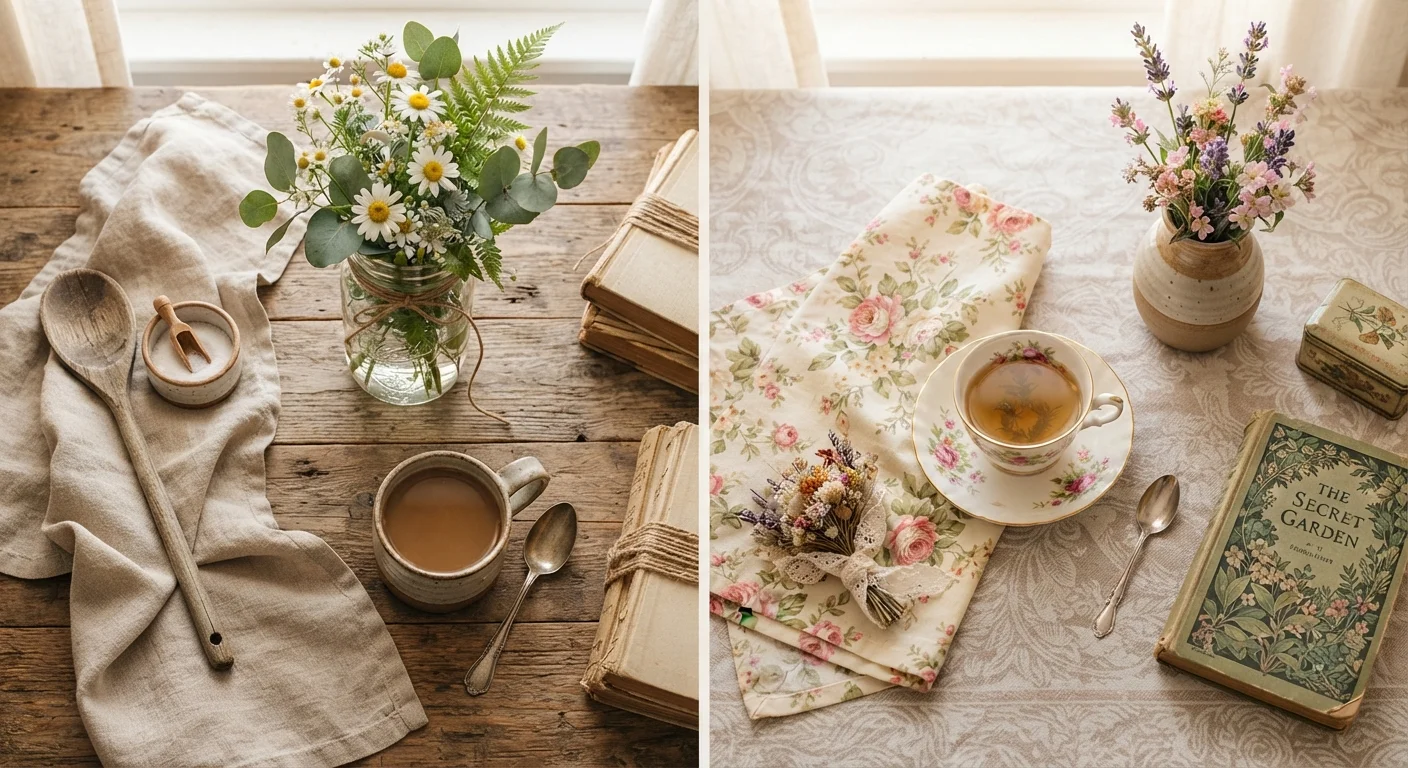
Farmhouse style is rooted in American rural practicality. Think: shiplap walls, galvanized metal accents, reclaimed wood beams, and open shelving stacked with utilitarian objects. The mood is hardworking and unpretentious — beautiful because it's functional, not in spite of it. Neutral palettes (whites, creams, blacks) dominate, and the overall feeling is grounded and slightly spare.
Cottagecore, by contrast, is explicitly romantic and fantasy-adjacent. It draws loosely from English and European countryside imagery — think floral wallpaper, mismatched vintage china, pressed botanical prints, and an abundance of soft, layered textiles. Where farmhouse is practical, cottagecore is whimsical. It's less about usefulness and more about evoking a feeling of refuge.
The quick test: if the room looks like it belongs in a working barn, it's farmhouse. If it looks like a fairy-tale cottage tucked into the woods, it's cottagecore.
Japandi vs. Scandinavian Minimalism
Both styles value simplicity, natural materials, and uncluttered spaces — and both have become enormously popular in American homes. But they arrive at that simplicity from different philosophical directions.
Scandinavian minimalism is shaped by the Nordic concept of hygge (a Danish and Norwegian word meaning coziness and contentment). It prioritizes warmth, function, and accessibility. Rooms tend to be light-filled, with white or pale gray walls, blond wood, and cheerful pops of color. The feeling is optimistic and welcoming.
Japandi fuses that Scandinavian sensibility with Japanese wabi-sabi — an aesthetic philosophy that finds beauty in imperfection, asymmetry, and impermanence. The result is slightly moodier: deeper neutrals, more textural contrast (think rough ceramics alongside smooth stone), and a meditative stillness. Japandi rooms often feel quieter and more deliberate than their purely Scandinavian counterparts.
“Wabi-sabi is the art of finding beauty in imperfection and profundity in nature, of accepting the natural cycle of growth, decay, and death.”
— Leonard Koren, Author and design theorist, 'Wabi-Sabi for Artists, Designers, Poets & Philosophers'
The practical difference: Scandinavian minimalism invites you to relax into a space. Japandi invites you to be present in one.
Modern vs. Contemporary — and Why It Matters
This is one of the most persistent mix-ups in decor conversations, and it has a clear explanation. Modern is a historical term. It refers to the Modernist design movement that emerged in the early-to-mid 20th century, shaped by designers and architects who believed in stripping away ornamentation in favor of clean lines, honest materials, and the principle that form follows function. Mid-century modern is a subcategory of this movement.
Contemporary simply means "of the present moment." It's a moving target — what reads as contemporary today will look dated in a decade. Contemporary spaces often borrow from multiple influences and can include rounded forms, bold statement pieces, or layered textures that pure Modernism would reject.
When In Doubt, Check the Lines
One of the fastest ways to distinguish modern from contemporary is to look at the furniture legs and edges. True mid-century modern pieces have tapered, angled legs and flat planes. Contemporary furniture is more likely to have curved or mixed-material bases. Color choices can also signal the era — warm teak tones belong to modern; cool grays and mixed metals lean contemporary.
In practical terms: a room with teak furniture, flat planes, and no decorative trim is likely modern. A room with a curved sofa, mixed metals, and a sculptural light fixture is more likely contemporary — even if it also has some clean lines.
Traditional vs. Transitional
Traditional style draws from European — particularly English and French — decorating conventions. It features symmetry, rich wood tones, ornate furniture silhouettes, and layered patterns like damask, plaid, and florals. The overall effect is formal and established.
Transitional style intentionally softens those elements. It keeps the solid, well-proportioned furniture of traditional design but strips away the ornamentation, updates the fabrics to something more neutral, and introduces cleaner lines. The result is a room that feels timeless rather than period-specific — neither stiffly old-fashioned nor aggressively trendy.
Transitional is one of the most popular styles in American homes for exactly this reason: it's forgiving, adaptable, and works well when mixing secondhand and new furniture. If a room looks "classic but not stuffy," it's probably transitional.
Understanding where your instincts naturally land — and what a style is actually trying to say — helps you make more intentional choices, whether you're decorating a whole home or simply figuring out how to personalize a rental without overcommitting. And if you're curious about the opposite end of the spectrum, living with maximalism explores what happens when restraint goes out the window entirely.