
Why Roundabouts Exist and Why They Work
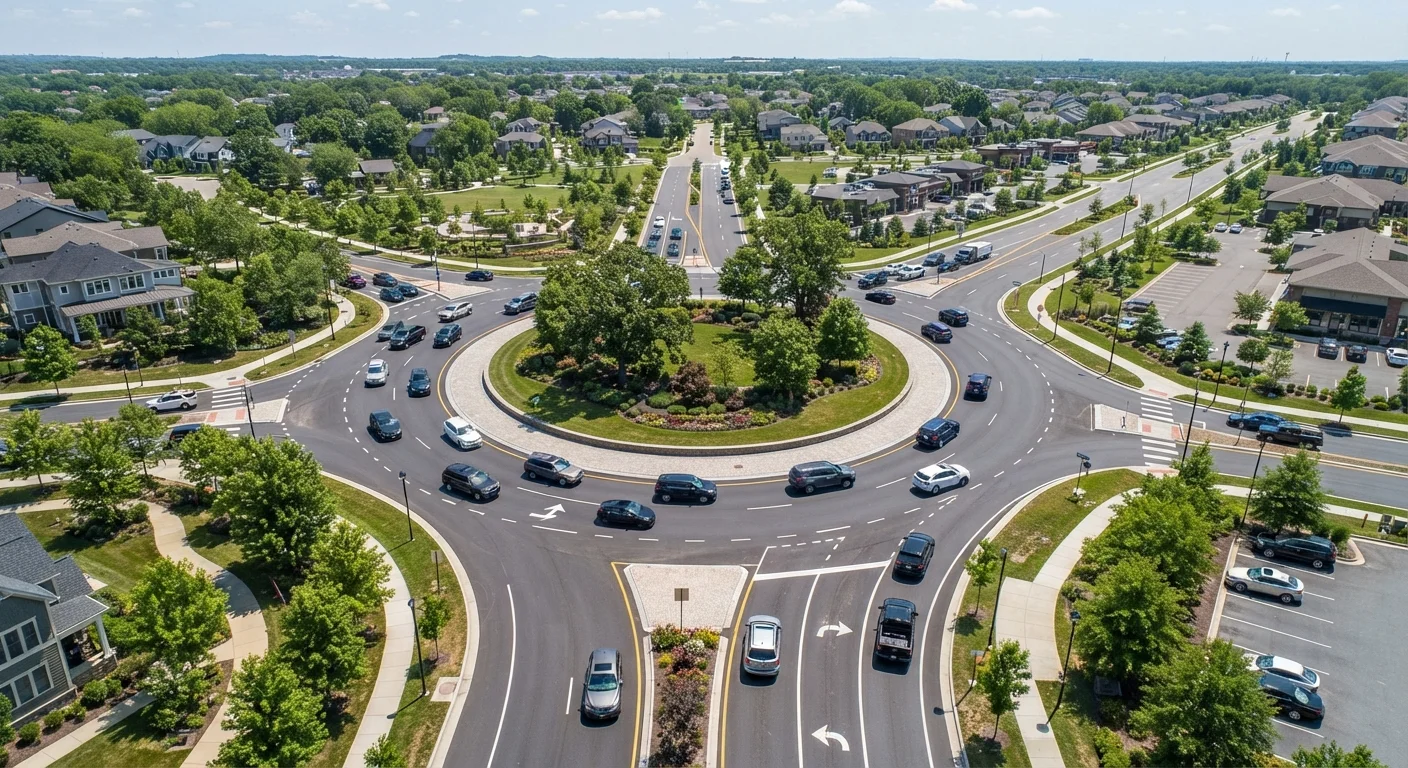
Roundabouts replaced tens of thousands of traditional stop-sign and signal-controlled intersections across the United States over the past two decades. The reason is straightforward: the geometry eliminates the highest-severity conflict points. At a conventional four-way intersection, vehicles meet at right angles — producing T-bone (broadside) crashes that are among the deadliest collision types. In a roundabout, all traffic moves in the same direction at reduced speed, so any impact occurs at a glancing angle with far less force.
Research published by the Insurance Institute for Highway Safety has consistently found that converting conventional intersections to roundabouts reduces fatal and serious-injury crashes by a substantial margin. They also reduce overall delay and fuel consumption compared with timed signals. Understanding why roundabouts are built this way helps drivers appreciate that the rules are not arbitrary — they are the mechanical logic that makes the safety benefit possible.
Part of what makes roundabouts confusing is that they require drivers to make several quick decisions: when to yield, which lane to use, when to signal. These decisions feel unfamiliar because most American drivers learned to drive on a grid of signalized intersections. The good news is that the rules are consistent at every roundabout in the country. Once learned, they apply everywhere. See our complete safe driving overview for broader context on intersection and road-rule fundamentals.
Vehicle mirrors (side and rearview)
Monitor circulating traffic and pedestrians in crosswalks before and during roundabout entry.
Turn signals
Indicate your intended exit to other drivers, cyclists, and pedestrians waiting to cross.
How to Navigate a Roundabout Correctly
The five steps below apply to both single-lane and multi-lane roundabouts. Multi-lane versions add complexity around lane selection, but the core logic — slow, choose, yield, maintain, exit — is identical.
What you will need
Slow down well before the roundabout
Reduce your speed as soon as you see the roundabout warning sign — typically a yellow sign with a circular arrow. Most roundabouts are designed for travel speeds of 15–25 mph inside the circle, so approach at a speed that allows a full stop at the yield line if needed. Avoid braking hard at the last moment.
Choose the correct lane before the entry
At multi-lane roundabouts, lane choice is made on the approach, not inside the circle. As a general rule: use the right lane for right turns or the first exit, the left lane for exits past the halfway point (such as a left turn or U-turn), and either lane for straight-through movements. Always confirm with posted signs and pavement markings specific to that intersection.
Yield to circulating traffic at the yield line
At the dashed yield line, check for vehicles already traveling inside the roundabout. Traffic in the circle has the right of way — you must wait for a safe gap before entering. Do not assume that a gap will appear quickly; be prepared to stop. Only when the path is clearly open should you enter at a consistent, controlled speed.
Stay in your lane while circling
Once inside the roundabout, maintain your chosen lane and match the natural curve of the road. Do not change lanes inside the circle. Keep a consistent speed and stay alert for vehicles entering from other approaches — they should yield to you, but not all drivers follow the rules correctly. Check your mirrors for blind spot hazards along the curve.
Signal your exit and exit smoothly
Before your intended exit, activate your right turn signal. This alerts pedestrians in the crosswalk ahead and other drivers waiting to enter. After signaling, steer smoothly toward your exit lane, check for pedestrians at the crosswalk just beyond the exit, and accelerate gradually back to road speed. Cancel your signal once you have fully exited.
Yield at Entry — Every Time
The single most critical rule at any roundabout is that entering drivers must yield to circulating traffic. This is not a merge with equal priority — it is a full yield. Failing to yield at entry is the leading cause of roundabout collisions in the United States. Come to a complete stop if necessary before entering.
Never Stop Inside the Roundabout
Stopping inside the circle to let someone enter is incorrect and dangerous. It disrupts traffic flow and can cause rear-end collisions behind you. If you miss your exit, continue around to the correct exit rather than stopping, reversing, or cutting across lanes.
Use Lane Markings as Your Guide
Multi-lane roundabouts typically paint arrows and destination labels on the approach. Read these before you reach the yield line — not while you're already circling. Pavement markings, combined with overhead signs, give you all the information needed to choose the correct lane in advance.
Roundabouts reward the same habits that define defensive driving: reading the road ahead, adjusting speed early, and making your intentions clear to others. Drivers who struggle with roundabouts often struggle because they are reacting at the yield line rather than preparing 200 feet back. Like highway merging, the key is anticipation — not last-second improvisation. For help interpreting the approach signs and lane markings, road sign reference guidance is a useful companion resource.