
Why Throw Pillows Matter More Than You Think
Throw pillows are one of the few decor elements that can change a room's entire personality without touching a wall or moving a stick of furniture. They introduce color, break up visual monotony, and signal whether a space feels casual or polished. Done well, they tie together a sofa, a palette, and a mood in one cohesive statement. Done poorly, they look like an afterthought — or worse, a pile of laundry.
The good news: choosing throw pillows well is a learnable skill. It comes down to understanding a few consistent principles around size, quantity, fabric, and pattern — then applying those principles room by room.
For a broader look at how grouping and proportion shape a room's feel, see our guide on the rule of three in home decor.
The Basics: Sizing, Quantity, and Arrangement
Before diving into specific rooms, a few universal rules apply everywhere.
Sizing
Match pillow size to furniture scale. A standard sofa handles 20"–22" pillows comfortably as anchor pieces. Smaller accent pillows (16"–18") can layer in front. Accent chairs, window seats, and loveseats call for 16"–18" as the primary size. Going too small on a large sofa makes pillows look lost; going too large on a narrow chair looks crowded.
Quantity
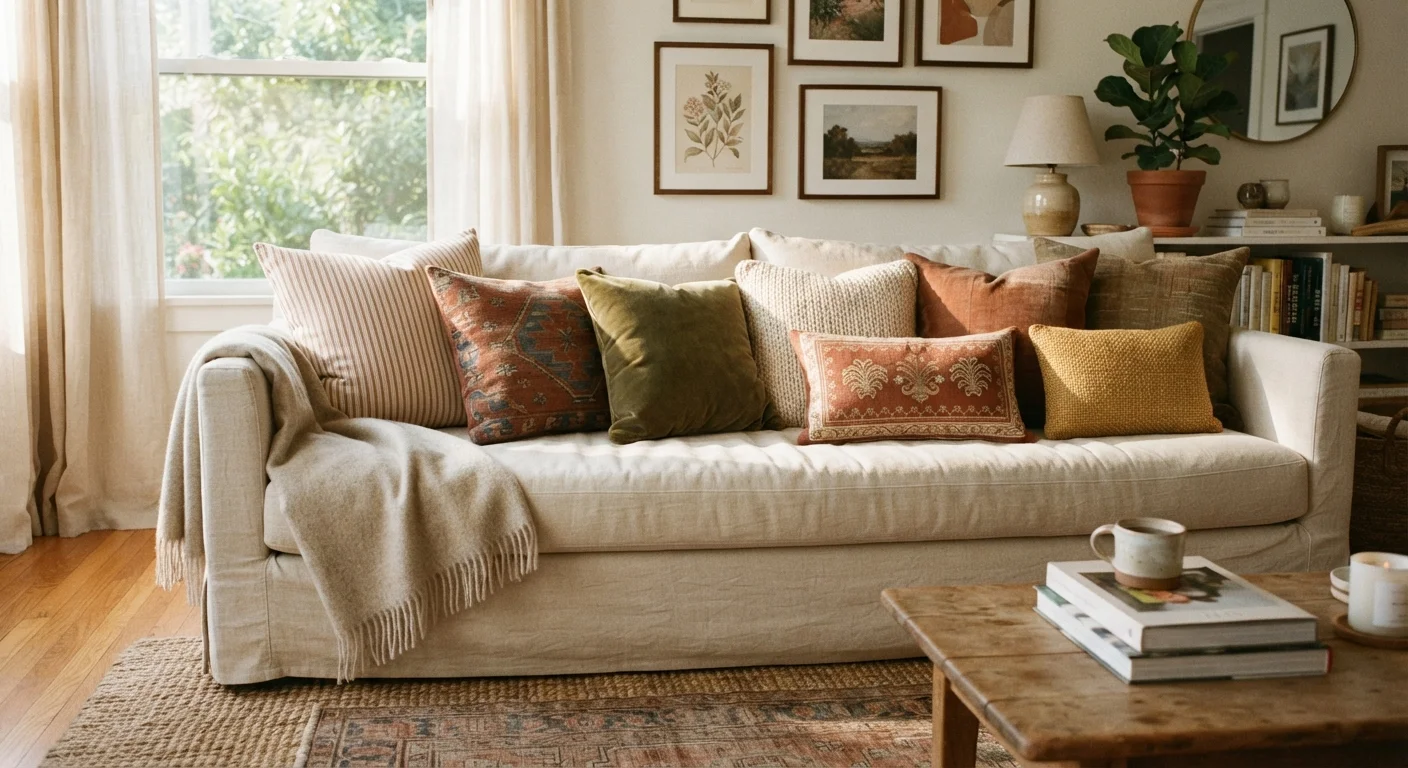
Odd numbers almost always look more natural. On a three-cushion sofa, three or five pillows tends to work better than four. On a loveseat, three is a reliable starting point. The exact number matters less than ensuring the arrangement doesn't block seating or look symmetrically rigid.
Always buy pillow inserts one to two inches larger than your cover size. A 20" insert in an 18" cover produces a full, plump look rather than a flat, sad rectangle.
Down or down-alternative inserts compress over time, and a slightly oversized insert compensates for this while also making covers look purposefully styled from day one.
When in doubt, the 'karate chop' — a firm indent pressed into the top center of a plump pillow — is a simple finishing touch that signals intentional styling without effort.
Interior stylists use this technique consistently in photo shoots and model homes because it adds a relaxed, lived-in quality that stiff, upright pillows lack.
Arrangement
A practical formula: start with two larger pillows on the outer edges, add two medium pillows inside those, and finish with one smaller or lumbar pillow at the center. This creates depth without requiring design training.
Living Room: Anchor the Space
The living room sofa is the primary canvas for throw pillows in most homes. Because this space gets the most visual attention, it rewards a bit more intentional planning.
Start with a dominant color drawn from the room — a rug, a curtain panel, or a wall accent. Build at least one pillow around that color. Then add one or two pillows in a neutral that already lives in the room (warm white, linen, charcoal). The third element can be a pattern — a geometric, a subtle floral, or a stripe — that bridges the two.
Swap Covers, Not Whole Pillows
Pillow covers with zippers or envelope backs let you change the look of a sofa for the cost of the cover alone — typically far less than buying new filled pillows. Keep a set of neutral covers and one or two seasonal accent covers to rotate throughout the year. This approach is particularly budget-friendly when refreshing a living room.
For high-traffic living rooms, prioritize covers with zippers or removable shells. This lets you swap covers seasonally or wash them without replacing the entire pillow — an easy way to refresh the room without spending much.
If your living room feels visually cramped, pillow scale and quantity may be contributing. Oversized or overly numerous pillows can push a small space toward chaos.
Bedroom: Layered and Restful
Bedroom throw pillows serve a different purpose than living room pillows — they're primarily visual, not functional, since most people remove them before sleep. This means you have a bit more creative freedom, but also a responsibility to keep the arrangement from feeling fussy.
A standard queen bed works well with two Euro squares (26") as the back row, two standard sleeping pillows in decorative shams in front, and one or two accent pillows (18"–20") in the front layer. A lumbar pillow centered at the front adds a polished finish without overdoing it.
Bedroom Pillows Are Primarily Visual
Unlike living room pillows, most bedroom decorative pillows come off the bed every night and go back on each morning. Factor that daily habit into your arrangement: a bed that takes five minutes to make because of elaborate pillow stacking often gets abandoned. Keep the arrangement simple enough that it's genuinely sustainable for your routine.
Bedroom pillows are a good opportunity to introduce richer, more delicate fabrics — velvet, linen, embroidered cotton — that you might avoid in a high-use living room. Keep color in the bedroom softer and more restful: muted tones, warm neutrals, and gentle contrast rather than bold graphic patterns.
If you're working with texture as a design tool, the bedroom bed styling is one of the most accessible places to layer textiles.
Other Rooms: Nooks, Kids' Spaces, and Outdoor Areas
Reading nooks and window seats benefit from smaller, firmer pillows (16"–18") that support posture as well as look good. A mix of two to three pillows in complementary but not identical fabrics tends to feel casual and inviting.
Kids' rooms call for washable covers above all else. Look for covers in cotton or polyester blends that can go in the machine. Fun shapes — animals, geometric forms — work well here and don't need to coordinate with a broader room palette the way adult spaces do.
Outdoor spaces require pillows specifically rated for outdoor use. Look for fabric descriptions like solution-dyed acrylic or polyester with UV and moisture resistance. Never use indoor-only pillows outside long-term — the fill and fabric will degrade quickly with exposure. Store outdoor pillows inside during extended rain or off-season periods to extend their life.
Renters decorating outdoor balconies or patios should note that outdoor throw pillows are among the most deposit-safe upgrades available. For more ideas on decorating without permanent changes, see our guide on decorating a rental without losing your deposit.
Fabric and Pattern: Matching the Room's Purpose
Fabric choice is often treated as an afterthought, but it's one of the first things a visitor will notice when they sit down — or when light hits the sofa from across the room.
60%+
Homeowners who redecorate using soft furnishings first
Industry surveys consistently find that textiles — including throw pillows and rugs — are among the most common first purchases when refreshing a room, ahead of paint or furniture.
3–5
Pillows recommended for a standard three-seat sofa
Interior design guidelines broadly suggest odd-number groupings of three to five pillows as the most visually balanced range for a typical living room sofa.
Fabric by Room
- Living rooms: Cotton, linen-cotton blends, and performance velvet balance durability and style well.
- Bedrooms: Velvet, silk-look polyester, and embroidered cotton reward low-traffic use with visual richness.
- Kids' rooms: Tightly woven cotton or polyester — machine-washable always.
- Outdoors: Solution-dyed acrylic or UV-rated polyester only.
Pattern Guidelines
Limit yourself to two or three pattern types in one arrangement. A reliable mix: one solid, one geometric or stripe, one organic or botanical pattern. Vary the scale of patterns — a large-scale print with a small-scale texture reads as curated rather than chaotic.
If your furniture itself has a strong pattern (a plaid sofa, a floral chair), lean toward solid or subtle textured pillows to avoid competing. Solid-colored furniture gives you more freedom to experiment with patterned pillows.
Mixing pieces from different sources — thrifted, gifted, or newly purchased — is entirely workable with this approach. For guidance on making disparate pieces feel unified, see secondhand furniture in a new home: making it feel cohesive.
Avoid Over-Accessorizing Small Furniture
More pillows is not always better. On a loveseat or small sofa, exceeding three to four pillows can leave virtually no seating space and make the arrangement feel cluttered rather than styled. If guests consistently move your pillows to the floor before sitting down, that's a reliable sign you've crossed the line from decorative to excessive.